Conversion value: revenue or an estimate?
Conversion value is a number supplied for a specified completed action. It is not guaranteed to be collected revenue. A lead can receive an assigned USD 20 value, while a paid order reports USD 80. Both can appear in value reports, but they answer different questions. When a media buyer sees “value / ad spend: 4x,” the first question should be what the numerator contains.
Google Ads' conversion-value guidance allows values for objectives such as revenue or profit, with fixed or transaction-specific amounts. That is a measurement and bidding choice. A column name does not establish accounting income. Review ROAS's numerator and denominator before calling a report revenue efficiency.
One traffic cohort, three different ratios
Everything below is hypothetical, not customer results. One campaign's clicks acquired during a week in Asia/Taipei cost USD 400. Use a seven-day click attribution window and wait until the final day's clicks complete it. Confirm 50 deduplicated completed leads, including 20 distinct orders, and reconcile the example's payments and refunds. All amounts are USD and belong to that traffic cohort.
The team assigns USD 20 to each lead. Total lead estimate = 50 × 20 = USD 1,000. This setting does not establish USD 1,000 collected. The 20 orders each actually pay USD 80, totaling USD 1,600. Those prices already reflect discounts, and this example excludes tax and shipping. A later USD 200 refund against those orders leaves USD 1,400 in merchandise receipts after refunds.
| Value basis | Amount | Value / ad spend |
|---|---|---|
| Assigned lead value | USD 1,000 | 2.5x |
| Paid orders | USD 1,600 | 4x |
| After refunds | USD 1,400 | 3.5x |
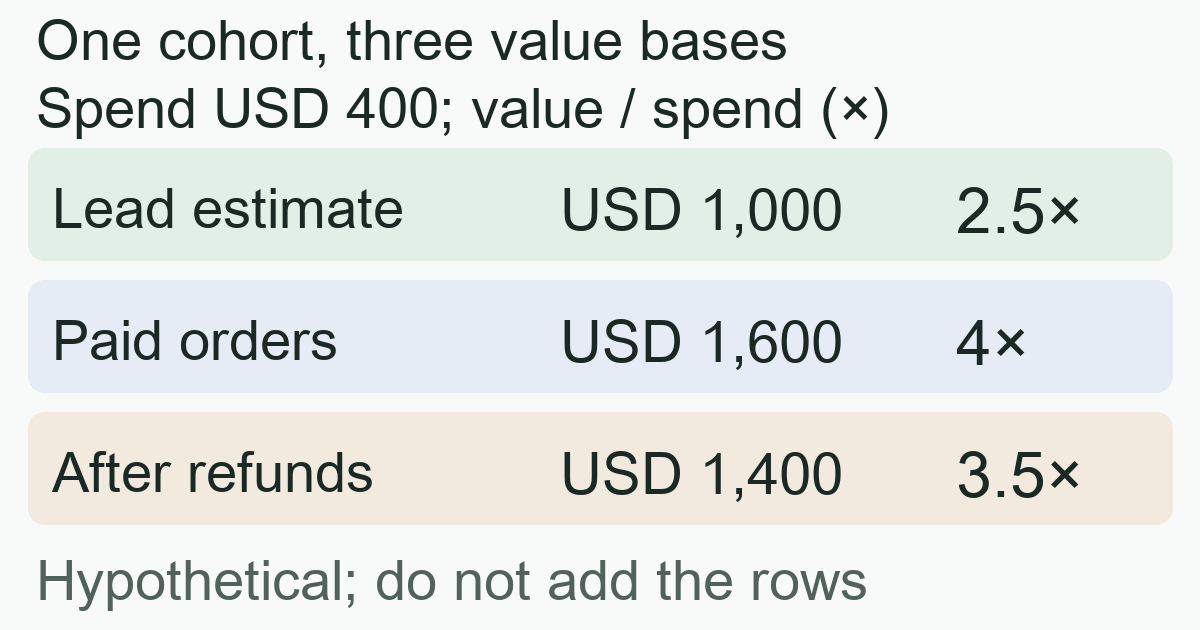
The ratios do not contradict each other: 1,000 / 400 = 2.5; 1,600 / 400 = 4; 1,400 / 400 = 3.5. Only the final row matches this example's chosen merchandise-income basis after refunds. It still excludes product, payment, and operating costs. It does not replace accounting recognition or a complete cash-flow report; payment, accounting revenue, and profit require separate reconciliation.
When is an assigned lead value useful?
An estimate can distinguish the importance of different leads, for example by using validated closing probabilities and subsequent value. But an arbitrary USD 20 setting can improve a report without improving the business. Changing it to USD 40 doubles the same 50 leads' value from USD 1,000 to USD 2,000 and the ratio from 2.5x to 5x. Sales and money collected have not changed.
Keep the estimate's evidence, version, and effective date, and validate it against subsequent completions. Campaigns using different versions are not directly comparable. This example does not validate USD 20 as a suitable estimate; it illustrates the distinction.
Do not add USD 1,000, USD 1,600, and USD 1,400 into USD 4,000 and claim 10x revenue ROAS. The lead estimate overlaps the order journey, while the after-refund amount is another presentation of those orders, not another sale. Choose a revenue basis before applying break-even ROAS. A profit value or lead estimate cannot inherit a threshold derived from revenue.
Check reporting totals and bidding goals separately
Receiving an event is only one check. Which action and value guides optimization is another. Google Ads' primary and secondary conversion guidance explains that primary actions participate in bidding when their standard goal is used. Secondary actions are normally for observation, but can be used for bidding when included in a custom goal.
Making a lead secondary therefore does not establish that every campaign excludes it from bidding. Inspect the campaign's actual goals and value columns, then check whether observation-only leads have been mixed into a revenue total. This article does not prescribe an account configuration: first decide whether the objective is leads, orders, or a specified expected value.
Reconcile refunds, currency, and timing
Did the refund reach the report? A refund in finance does not establish that tracking deducted it. GA4's ecommerce documentation calls for separate refund data linked to the transaction. Google Ads conversion adjustments provide mechanisms to change a value or retract a conversion. These are platform-specific processes, not proof that a correction in one system synchronizes everywhere. Check acceptance and reflected values before comparing totals.
Are currency and cost scope aligned? USD 80 and TWD 80 are different amounts. Keep original currencies, conversion dates, and exchange-rate conventions. Specify tax, shipping, and discounts instead of adding unlike values. GA4 also requires a currency when sending value data. The example's USD 80 is already discounted; deducting the same discount again would be incorrect.
Are these the same orders? Grouping by click date and payment date can place an order in different weeks. Align the attribution window and maturity, then check later payments and refunds. A seven-day window does not guarantee no subsequent refunds. With lead data alone, examine CPA for the specified completion. Do not fill missing revenue with zero or invented repeat-purchase value.
Four steps for a media buyer
- Name the columns clearly. Separate assigned lead value, paid order amount, and amount after refunds. Document currency, timing, and included charges.
- Trace one complete order journey. Match lead, payment, and refund records instead of treating them as three sales. Retries should retain the identifier for the same business fact.
- Align bidding and reporting definitions. Inspect actual campaign goals and estimate versions. Keep a change record when the value definition changes.
- Test with mature outcomes on a limited scope. Compare completion counts, spend, and the selected value. A higher ratio does not establish higher income or incremental revenue caused by ads. Mark missing information unavailable.
MeetROAS campaigns and connected downstream events can relate traffic to completed outcomes. Its public event documentation defines amounts as destination-reported value or revenue and distinguishes registration from effective deposits. This helps locate the event stage, but does not establish that a deposit is merchandise income or that refunds and full costs reconcile automatically. Check the actual events and amounts used by the report.
Frequently asked questions
Does value above revenue prove tracking is broken?
No. It may include lead estimates, different charges, attribution periods, or overlapping stages. Separate the event and value definitions before investigating missing events, retries, or unreflected refunds.
Can I use a fixed value without payment amounts?
A fixed value can be an explicitly labeled proxy if its evidence is documented and validated over time. It does not become collected revenue, and a “5x” ratio does not establish profit.
Sources
- Google Ads: About conversion values — Checked: 2026-10-17
- Google Ads: About primary and secondary conversion actions — Checked: 2026-10-17
- Google Analytics: Measure ecommerce — Checked: 2026-10-17
- Google Ads: About conversion adjustments — Checked: 2026-10-17
- MeetROAS: Partner Event API reference — Checked: 2026-10-17