Break-even ROAS: which costs are covered?
Break-even ROAS is the revenue-to-ad-spend ratio needed to avoid a loss within a stated cost scope. If USD 100 of net revenue leaves USD 40 after product, fulfillment, and other variable costs, the simplified threshold is 100 / 40 = 2.5x. That has not paid allocated rent or fixed salaries. It does not establish that the whole business is profitable.
Separate ROAS's revenue ratio from ROI's cost basis. A media buyer needs to know how much of each revenue dollar remains available to acquire traffic, rather than memorize a universal passing score.
The U.S. SBA's break-even guidance separates fixed and variable costs. We use that logic while listing advertising separately to make the threshold reproducible. The derivations and figures below are original teaching examples.
Calculate the contribution margin before advertising
Let R be net revenue from the selected orders. V is their variable cost, excluding advertising and fixed costs. Pre-ad contribution margin m = (R − V) / R. The contribution is available to cover advertising and overhead; it is not final profit.
V can include product cost, payment fees, and fulfillment or support costs that increase with orders. Classify actual expenses for your business. Shopify's contribution-format statement explains that variable/fixed classification differs from product-cost/administrative classification. An unspecified gross product margin cannot simply replace m. If a finance report already deducts advertising in its contribution margin, reconcile it to this pre-ad basis before deducting ads again.
Everything in this example is hypothetical, not customer results. One campaign's mature order cohort generates USD 1,000 net revenue during a week in Asia/Taipei. Corresponding V is USD 600 and ad spend A is USD 400. All amounts use the same currency. Revenue excludes discounts, refunds, and tax collected on behalf of authorities; costs match these orders. Use a seven-day click window, wait until the final clicks complete it, and reconcile the example's refunds. Recalculate if later adjustments arrive.
m = (1,000 − 600) / 1,000 = 40%. The USD 400 pre-ad contribution exactly covers USD 400 ad spend. ROAS = 1,000 / 400 = 2.5x. Contribution after ads, before allocated fixed costs, is zero.
Why is the formula 1 / m?
Without allocating fixed costs, break-even requires R × m − A = 0. Therefore R × m = A. Dividing by positive A and m gives break-even ROAS = R / A = 1 / m. Enter 40% as 0.40, not 40; 2.5x equals 250%.
| Pre-ad margin | Calculation | ROAS threshold |
|---|---|---|
| 20% | 1 / 0.20 | 5x |
| 40% | 1 / 0.40 | 2.5x |
| 60% | 1 / 0.60 | About 1.67x |
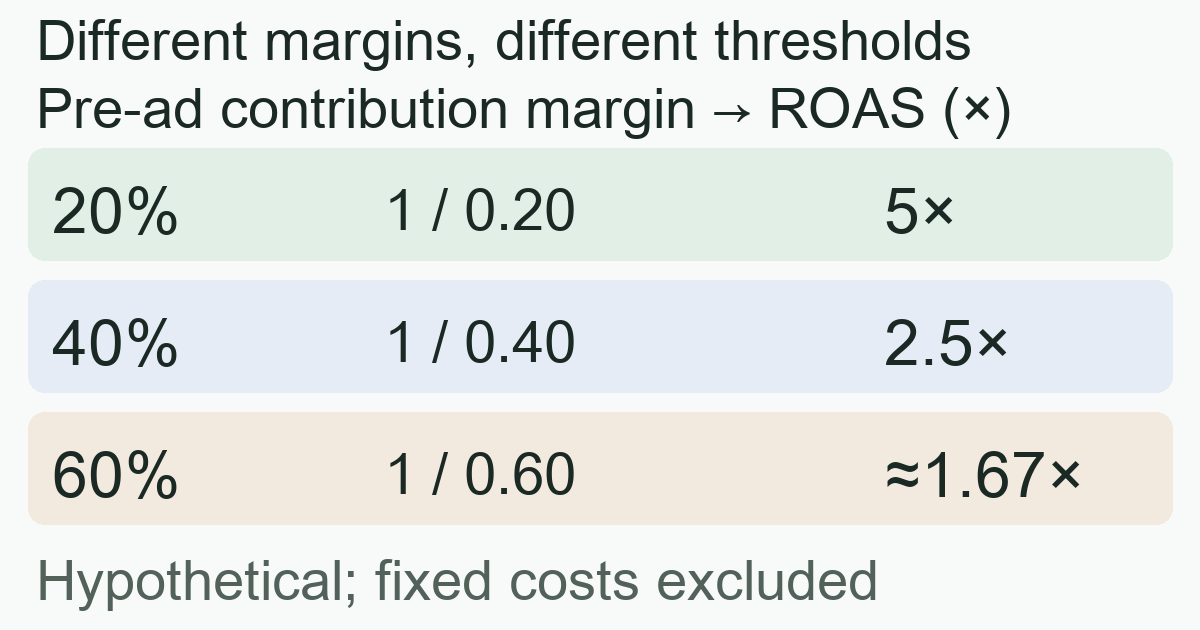
This hypothetical sensitivity comparison excludes fixed-cost allocation; the final result is rounded. It is not an industry benchmark or evidence that a 60% margin product is easier to advertise. Promotions, product mix, shipping, and payment charges can change m. Calculate it from the matched revenue and cost totals instead of averaging product margin percentages.
R and A must be positive, and m must exceed zero, for this finite positive threshold to apply. If there is no pre-ad contribution, proportionally increasing revenue cannot cover positive ad spend. Missing cost data means unknown economics, rather than zero cost.
What changes when fixed costs are included?
Return to the USD 1,000 revenue example. Allocate F = USD 100 of fixed expenses to the same scope. Simplified return P = R × m − A − F = 400 − 400 − 100 = −USD 100. The campaign breaks even at the earlier layer but loses money at this one.
With A fixed at USD 400, F at USD 100, and m assumed constant at 40%, the threshold including that allocation becomes (1 + F / A) / m = 3.125x ROAS. Required revenue is R = (400 + 100) / 0.40 = USD 1,250. V then becomes USD 750, giving 1,250 − 750 − 400 − 100 = zero return.
The 3.125x threshold applies only to this ad spend, fixed-cost allocation, and margin assumption. It is not a universal overhead-adjusted benchmark. Allocated rent does not mean the campaign caused additional rent. An incremental budget decision also needs the costs that actually change and the marginal outcomes; keep that question distinct from financial allocation.
Three mistakes that distort the threshold
Deducting discounts or refunds twice. A discount already removed from R should not also be added to V. After a refund, recalculate costs actually retained; do not assume all product, shipping, and payment costs are recovered. Reconcile a report still using original-price revenue before applying the threshold.
Treating another value as revenue. Google Ads Target ROAS optimizes using the conversion values supplied. Estimated registration value or pre-ad contribution is a different numerator from this article's net revenue. Do not apply its 2.5x threshold unchanged. With registrations alone, use CPA for the specified goal, rather than infer unmeasured revenue.
Assuming an above-threshold average guarantees profitable extra spend. Historical ROAS describes outcomes already acquired. Additional traffic can have different prices, audiences, and product mix. Attributed revenue also does not establish additional revenue caused by advertising. The threshold aligns economic assumptions; it does not replace mature data, a suitable comparison experiment, or actual cost checks.
For a worked budget decision, see marginal versus average ROAS: a hypothetical 4x average can coexist with a 2x added-spend step. The matching threshold must apply to that extra slice, not just the campaign total.
If reported conversion value is not merchandise income, first read the three conversion-value and revenue bases. Separate lead estimates, payments, and amounts after refunds before choosing the numerator for a threshold.
To compare the contribution left by current orders, see POAS and two identical 5x ROAS campaigns. It matches actual costs to advertising spend, a different question from setting the revenue threshold first.
A practical recalculation sequence
- Define R, V, A, and F with finance. State which expenses are already deducted and which are separate. Align order cohort, currency, dates, and mature window.
- Recalculate m from amounts. Adjust revenue for discounts and refunds, then reconcile retained costs. Do not simply average product percentages.
- Show both layers. Display contribution after ads and simplified return after allocated fixed costs. Record the allocation rule; incomplete expense coverage is not complete net profit.
- Update the promotion's threshold, then run a limited test. Compare additional spend, mature completions, and actual contribution. A high historical average alone does not justify scaling. Mark missing cost or event data unavailable.
MeetROAS campaigns and connected downstream events can help compare traffic with completed outcomes. Its event documentation distinguishes registration from a first effective deposit; the destination still supplies the facts. A deposit is not automatically this article's net revenue. Product costs, refunds, and overhead still require separate reconciliation before using a matching threshold.
Frequently asked questions
Should a bidding target equal break-even ROAS?
The threshold is an economic floor for particular costs, not a profit target or guarantee. Desired profit, data delay, and achievable performance need separate consideration. Setting a bidding target does not establish that it will be achieved.
Should a below-threshold campaign be stopped immediately?
First check maturity, complete revenue and costs, and the scope of the loss. Unverified future repeat-purchase value should not disguise a current shortfall. Record that assumption separately and validate it before deciding.
Sources
- U.S. Small Business Administration: Break-even point — Checked: 2026-10-16
- Shopify: Contribution Format Income Statement — Checked: 2026-10-16
- Google Ads: About Target ROAS bidding — Checked: 2026-10-16
- MeetROAS Developer Hub: Partner Event API and event catalog — Checked: 2026-10-16