ROAS measures revenue efficiency; ROI includes the cost of earning it
A media buyer reports “4x ROAS,” while the business owner says the campaign is losing money. Both can be right. ROAS compares revenue with advertising spend. ROI considers the costs included in the investment being evaluated. A 4x ROAS does not mean 3x profit or guarantee profitability.
This article compares revenue-based ROAS with an operating ROI whose cost scope is explicit. ROAS = attributed revenue / ad spend. Here, ROI = (revenue in scope − total related costs) / total related costs × 100%. Total related costs already include advertising: do not subtract it twice.
Use this quick comparison before the detailed cost example:
| Compare | Revenue ROAS | Operating ROI used here |
|---|---|---|
| Question | How much attributed revenue corresponds to ad spend? | What return remains after related costs? |
| Numerator | Attributed net revenue | Revenue in scope − total related costs |
| Denominator | Ad spend | Total related costs, including ads |
| Format | A multiple or its equivalent percentage | Scoped profit or loss as a percentage of costs |
| Useful for | Comparable advertising revenue efficiency | Profitability within the declared cost scope |
| Limitation | High ROAS does not establish profit | Missing costs or inconsistent allocations distort comparisons |
Google Ads describes the value-to-spend ratio in its Target ROAS documentation, while its ROI guide considers returns and costs together. Check what your conversion value represents before calling it revenue ROAS. A lead valuation or a profit-based value needs its own label.
One worked example: 4x ROAS with negative ROI
Every number below is hypothetical, not a customer result. Consider a cohort of orders attributed to one campaign. Traffic was acquired in September 2026, using Asia/Taipei time. Include orders within 30 days of each click and wait for reporting and refund data to mature. All amounts are USD. Revenue is net of refunds and discounts, excludes taxes collected on behalf of authorities, and costs are matched to these orders.
| Item | USD |
|---|---|
| Net revenue | 4,000 |
| Ad spend | 1,000 |
| Product, fulfillment and payment costs | 2,800 |
| Allocated labor and software | 400 |
| Total related costs | 4,200 |
| Profit or loss within this scope | −200 |
ROAS = 4,000 / 1,000 = 4x, or 400%. ROI = (4,000 − 4,200) / 4,200 × 100% ≈ −4.8%. Revenue covers advertising, but falls short of all the listed costs. The scoped loss is USD 200.
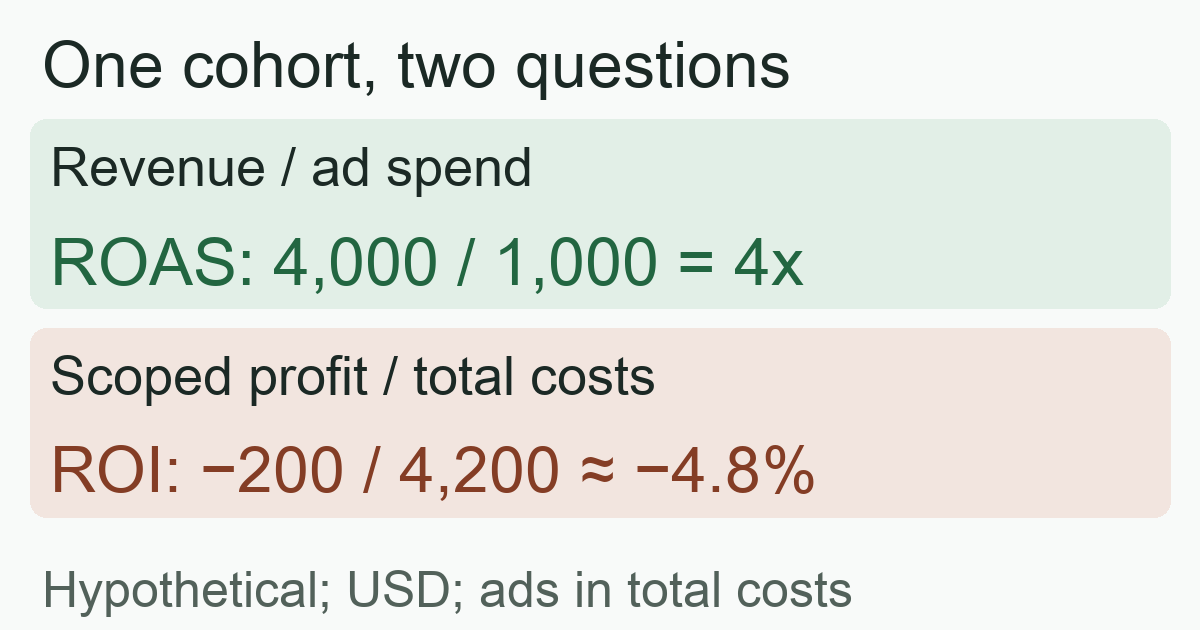
This is profit or loss within the declared scope, rather than the company's final net income. Income taxes, financing costs and other investments are excluded. Another cost scope can be useful, but label it. Ranking ROI figures with different cost definitions creates a misleading comparison.
Why the same ROAS can produce different business results
Use the same assumptions and mature measurement scope. Call the first cohort A; cohort B has the same revenue and advertising but lower product, fulfillment and payment costs. All amounts below are USD.
| Compare | A: higher costs | B: lower costs |
|---|---|---|
| Net revenue / ad spend | 4,000 / 1,000 | 4,000 / 1,000 |
| Product, fulfillment and payment costs | 2,800 | 2,400 |
| Allocated labor and software | 400 | 400 |
| Total related costs, including ads | 4,200 | 3,800 |
| Scoped profit or loss | −200 | +200 |
| Revenue ROAS | 4x | 4x |
| ROI used here | ≈ −4.8% | ≈ +5.3% |
The ad report gives both cohorts USD 4 of net revenue per ad dollar. Matching costs shows A losing USD 200 and B earning USD 200. ROAS is not miscalculated; its formula simply does not subtract product, fulfillment or allocated expenses. ROI also has a different denominator: −200 / 1,000 is not the ROI defined in this article.
Equal ROAS therefore does not mean both cohorts are equally attractive to scale when costs differ. Compare amounts too: a small campaign's high ROI does not necessarily yield a larger total contribution.
Use different reports for daily buying and business evaluation
Media buyers need relatively fast signals. When reporting scopes match and outcomes have matured, ROAS helps identify sources or creatives associated with more revenue. A higher ratio is insufficient grounds to move budget if product mix, refund rates or costs differ materially.
Operations or finance should match those orders to cost records and check whether the cohort leaves a positive return. Keep allocation rules consistent. For example, allocate labor by order count or software fees using an agreed proportion, and document the rule so next month's result remains comparable.
For a whole-business view, compare MER and ROAS using one monthly ledger. Total business revenue over defined marketing cost answers a different question from either campaign-attributed revenue or this article’s scoped ROI.
MeetROAS campaigns and connected downstream events can help link the acquisition journey with reported outcomes; its event integration guide explains the destination data required. Those events are not a product-cost ledger or a complete set of accounts. A deposit amount is not automatically recognized revenue. Calculating the ROI in this article still requires matching revenue and cost records from the business.
Before increasing budget, ask what the additional spend will earn
Average ROI describes a completed cohort. A budget increase concerns the next investment. Suppose another USD 100 of advertising produces USD 250 of additional net revenue, with USD 175 in additional variable costs and no additional labor or software expense. Additional contribution is 250 − 175 − 100 = −USD 25. Scaling can be unattractive even when the original campaign's average result looks healthy.
Observe that additional result through a controlled increase or a suitable experiment. It cannot be calculated from the previous average ROAS alone. Conversely, negative ROI after allocation does not mean stopping advertising saves every allocated dollar. A contracted software subscription or short-term fixed staffing expense may remain. Stopping a campaign, expanding it and evaluating overall business profitability are separate decisions.
A practical way to connect the reports
- Write down the decision: compare source efficiency, evaluate an order cohort's profit, or allocate additional budget. One ratio cannot answer every question.
- Fix the order scope, currency, time zone, attribution window and maturity date. The 30-day window here is an example, not a universal requirement.
- Reconcile net revenue using orders or transaction totals, then match product, fulfillment, payment, advertising and allocated costs. Count each expense once.
- Show ROAS, scoped profit or loss, ROI and the cost definition separately. Mark incomplete calculations as unavailable. Missing cost is not zero cost.
- Investigate anomalies before testing a modest change. If payment data is not connected, use CPA and distinct conversion goals rather than translating registrations directly into revenue.
For click or registration costs, first use the same-cohort CPC, CPA and ROAS comparison. Those costs cannot substitute for measured payment revenue.
For the basic numerator and denominator, read the ROAS formula and common mistakes. Also distinguish attributed revenue from additional revenue caused by advertising. Establishing incrementality requires an appropriate comparison experiment; the ROI equation cannot establish causality.
Frequently asked questions
Are 400% ROAS and 400% ROI interchangeable?
No. The former describes USD 4 of attributed revenue per advertising dollar. Under this article's definition, the latter describes profit equal to four times total related costs. Both the denominator and the treatment of costs differ.
Is ROI always more useful than ROAS?
It depends on the decision. ROAS describes defined advertising revenue efficiency; ROI evaluates a return within a specified cost scope. An apparently precise ROI is still misleading when costs are incomplete or allocations are distorted.
What if advertising spend is zero?
Revenue ROAS has a zero denominator and should be marked not applicable. The ROI ratio here requires positive total related costs and complete inputs. Distinguish missing information from a genuine zero expense.
Sources
- Google Ads: About Target ROAS bidding — Checked: 2026-10-19
- Google Ads: About return on investment (ROI) — Checked: 2026-10-19
- MeetROAS: Partner Event API — Checked: 2026-10-19