What is CPA? Name the action first
CPA (cost per action) is advertising spend divided by conversions counted under a stated set of rules. The action might be a completed registration, a valid inquiry, or a purchase. It does not automatically mean acquiring a new paying customer. Google Ads defines average CPA using conversion counts and distinguishes observed average CPA from a bidding strategy's target CPA.
Average CPA = corresponding advertising spend / counted conversions. The unit is money per specified action, such as USD 10 per completed registration. A report labeled only “CPA 10” omits both the currency and the outcome. Cost per acquisition is also abbreviated CPA; when you see that term, ask whether acquisition means registration, an order, or a first-time paying customer.
The metric also differs from a billing contract. You can buy traffic by the click or by a thousand impressions and still calculate the resulting CPA. If a provider charges per action, its contract defines eligible actions, deduplication, and rejected outcomes. Setting a target of USD 10 does not guarantee that every individual action will cost USD 10.
A hypothetical example: one spend, two denominators
This is a teaching example, not customer performance. A campaign spends USD 120 during one week. After aligning currency, time zone, and attribution rules and allowing the selected conversion window to mature, it records 12 completed registrations. Three of those people become first-time paying customers. Assume one registration per person, valid payments, and all these outcomes attributed to the same spend.
| Metric | Event and count | Calculation | Result |
|---|---|---|---|
| Registration CPA | 12 completed registrations | USD 120 / 12 | USD 10 per registration |
| Ad cost per new paying customer | 3 first-time paying customers | USD 120 / 3 | USD 40 per new customer |
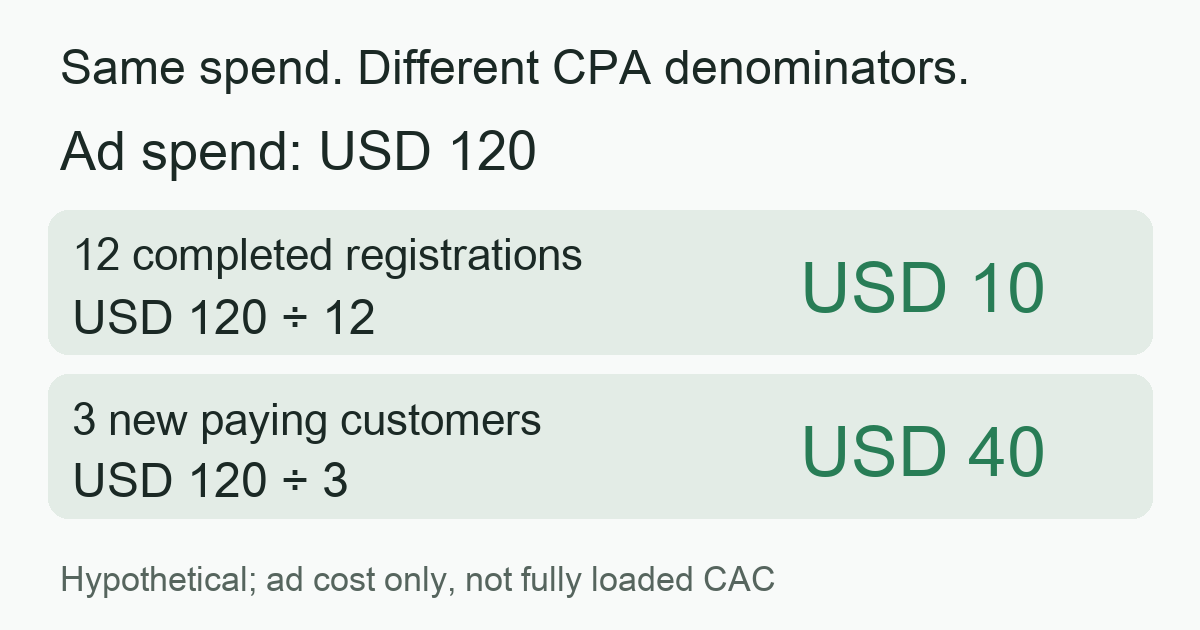
The registration-to-payment conversion rate is 3 / 12 = 25%. USD 10 and USD 40 answer different questions. Adding both stages into 15 “conversions” would produce USD 8, but the denominator mixes two actions from some of the same people. It represents neither registration cost nor cost per new paying customer.
Customer acquisition cost (CAC) requires a consistent scope of relevant sales and marketing expenses divided by new customers. Shopify's CAC guide includes costs such as staff, tools, and content. The USD 40 advertising-only figure is not a fully loaded CAC. Repeat orders also cannot stand in for new customers.
Event definitions and counting rules change CPA
Write a verifiable completion condition. Registration should mean an account was successfully created, not a registration-button click. An inquiry should mean a valid submission, not opening a form. A first payment should exclude failed payments and existing paying customers. Replacing a completed action with an easier click changes the question, even if the number improves.
Google Ads documents conversion counting options for counting one or every conversion after an ad interaction, with different choices for different conversion actions. This does not establish globally unique customer counting. A person returning through another click is not necessarily counted only once. Before comparing reports, identify whether the denominator contains events, orders, one action per click, or unique new customers.
After defining the action, check which primary or secondary conversions guide Google Ads bidding. Campaign goal selection and custom-goal membership determine whether a registration is merely observed or pursued as an optimization outcome.
For your own event feed, define retry handling too. A retry of the same transaction should preserve a stable event identifier. Two different identifiers do not automatically establish two distinct transactions. Test a success, an identical retry, and a failed action, then reconcile totals against the destination system. A browser request being sent does not prove that the backend completed the business action.
Why a low CPA is not enough
A lower CPA can reflect cheaper traffic or a better conversion rate, but it can also reflect a looser event definition. In the hypothetical example, doubling registrations to 24 while keeping only three new paying customers reduces registration CPA to USD 5. Ad cost per new paying customer remains USD 40. Investigate downstream quality before increasing budget just to buy more registrations.
When comparing click prices, the CPC and conversion-rate example shows how clicks at half the price can still produce twice the registration CPA. Check whether those clicks continue to complete the same goal.
CPA measures the cost of a specified outcome; ROAS measures attributed revenue relative to ad spend. Without revenue data, a low CPA cannot establish profitability. With revenue data, you still need margin, refunds, and a clear cost scope. There is no universal good CPA across industries. An acceptable ceiling depends on the realizable value of the action and the payback period you can support.
If you spend USD 120 and reliably observe zero conversions, dividing by zero makes CPA undefined. Report “not applicable” or “no conversions yet,” rather than USD 0. If tracking is disconnected, the result is unavailable, not proof of zero conversions. Google's conversion-delay guidance also explains why recent data may be incomplete. Today's immature CPA should not be compared directly with a mature week.
Once the completed event is consistent, use the traffic-source budget worksheet to compare paying customers, net revenue and contribution after advertising before planning a capped budget test.
For a practical source-quality diagnosis, use the registration-to-paying-customer worksheet. Its device breakdown shows why different overall payment rates can reflect a different customer mix, even when comparable groups have the same observed rate.
Five steps to make CPA actionable
- Define the outcome. Record the completion condition, repeat-counting rule, and whether only new customers qualify.
- Align scope. Use the same campaign, currency, time zone, date basis, and attribution window. Align definitions before comparing sources.
- Confirm coverage. Verify both spend and event data. Distinguish unavailable data, zero outcomes, and immature outcomes.
- Validate the denominator. Reconcile destination records and examine retries, duplicate payments, and incomplete submissions under consistent counting rules.
- Change one testable factor. For example, test whether the page matches the ad's promise, then monitor mature CPA and downstream paying-customer quality. Changing the goal and creative together obscures the explanation.
When the problem is “we have clicks, but cannot see where the journey loses people,” MeetROAS campaign pages and connected downstream events can help observe those stages. Its Developer Hub event definitions separate completed registration from first deposit. Results remain limited by the data actually connected; a first deposit also does not directly establish the merchant's net revenue or profit.
Frequently asked questions
Is CPA the same as target CPA?
No. This article calculates the average cost of observed outcomes. Target CPA is the average a bidding strategy aims to achieve. Compare the same conversion event and scope, and check reporting delays.
Can I combine registrations and purchases into one CPA?
Only if that mixed set of actions is the outcome you deliberately want to measure, with explicit weighting and repeat-counting rules. Separate calculations better answer questions about registrations or new paying customers.
Can missing cost data be treated as zero CPA?
No. Missing spend makes CPA unavailable. Known zero spend with a positive conversion count produces zero mathematically. A zero conversion count still makes the formula undefined.
Sources
- Google Ads: Average CPA definition — Checked: 2026-10-09
- Google Ads: About conversion counting options — Checked: 2026-10-09
- Shopify: Customer Acquisition Cost (CAC): Calculate and Reduce It — Checked: 2026-10-09
- Google Ads: Find out how long it takes for your customers to convert — Checked: 2026-10-09