Cheap registrations do not necessarily mean cheap paying customers
Registration CPA measures the advertising cost of a completed sign-up. Ad cost per new paying customer measures the cost of someone making a first valid payment. When cheap registrations rarely progress to payment, the second cost can remain high. Before blaming the traffic source, check whether payments are observable, cohorts have equal follow-up time, and the sources attract comparable people.
A registration is an account successfully created, rather than a button click. A paying customer here is a distinct person making a first successful payment, rather than an order count or a returning customer's next payment. Google Ads' average CPA definition divides cost by conversions; naming the conversion determines what the number means. See CPA's denominator guide for the basic formula.
Google's qualified-lead and converted-lead guidance also separates earlier and later business stages. A qualified lead has been further assessed; a converted lead completes a business-defined step, which need not itself prove payment. Define a verifiable payment condition when paying customers are the question.
One mature cohort: A buys cheaper sign-ups; B buys cheaper payers
All figures are hypothetical, not customer results. Two campaigns target new prospects for the same product and offer. Use September 1–7, 2026 ad-click cohorts in Asia/Taipei. Assume one click per person, exclusive assignment to A or B, and that registrations from these clicks occur on the same day. This simplifying assumption aligns weekly spend and registrations; real delayed registrations need their original acquisition cohort.
Count each person's registration once, then their first valid payment within fourteen days after registration. All payers belong to these registrants; exclude existing customers, test payments, failed payments and payments voided by the September 25 reconciliation. Later payments do not enter this fourteen-day outcome. Fourteen days is the example's chosen horizon, not a universal sales-cycle threshold or a platform attribution setting.
| Metric | Campaign A | Campaign B |
|---|---|---|
| Actual advertising spend, USD | 300 | 500 |
| Distinct completed registrations | 200 | 200 |
| New payers within fourteen days | 8 | 16 |
| Registration CPA, USD | 300 / 200 = 1.50 | 500 / 200 = 2.50 |
| Registration-to-first-pay rate | 8 / 200 = 4% | 16 / 200 = 8% |
| Ad cost per new payer, USD | 300 / 8 = 37.50 | 500 / 16 = 31.25 |
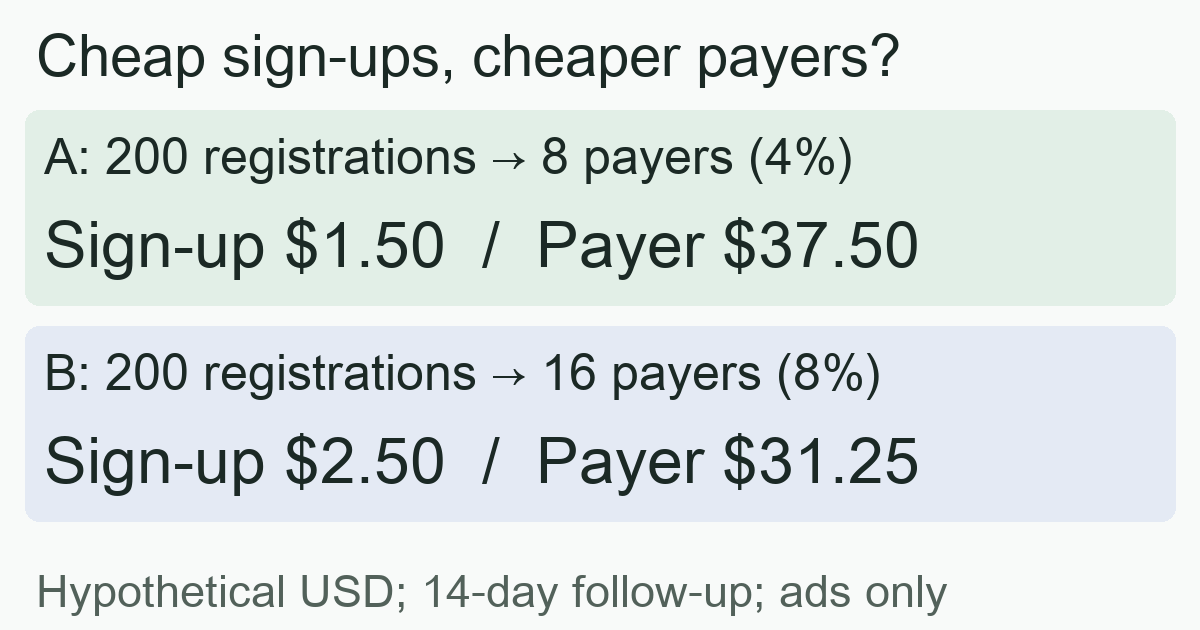
A's sign-ups cost less, but B's observed ad cost per new payer is lower. Within exactly this cohort and cost scope, ad cost per payer = registration CPA / registration-to-pay rate: A is 1.50 / 0.04 = USD 37.50. Divide by 0.04, not by 4.
These advertising-only costs exclude staff, tools and other sales or marketing expenses; they are not fully loaded customer acquisition cost. Payment counts alone also omit payment value, margins and refunds. Lower payer cost does not establish greater profit or justify immediately increasing budget. With eight and sixteen payers, a few outcomes can substantially change the comparison.
Check the customer mix before calling a source low quality
Break down that same hypothetical cohort by the device at the original acquisition click. If someone later pays on another device, retain their original group using the destination's customer records. The counts still reconcile to 200 registrations and eight or sixteen payers:
| Acquisition device | A: registrations → payers | B: registrations → payers |
|---|---|---|
| Mobile | 150 → 3 = 2% | 50 → 1 = 2% |
| Desktop | 50 → 5 = 10% | 150 → 15 = 10% |
Within each device group the observed payment rates are identical. B has more desktop registrations, whose payment rate is higher in this example. The overall 4% versus 8% therefore cannot, by itself, establish that B's source produces better people under comparable conditions.
The actual overall costs remain USD 37.50 and USD 31.25. This breakdown changes the diagnosis, not the arithmetic. Without spend by device, it does not establish which source acquires mobile or desktop payers more cheaply. Nor do these small groups prove that device caused the difference. Examine country, promotion and customer eligibility alongside device, rather than treating one label as an explanation.
Separate missing evidence from payment abandonment
Google's conversion-delay guidance explains why recent conversions may still arrive. Compare the same follow-up age, not this morning's registrations with last month's mature customers. A fixed horizon also measures only payments inside that horizon; it does not label everyone else a permanent non-buyer.
- Destination shows valid payments; the acquisition report cannot link them → check customer matching, source assignment and reporting coverage.
- Comparable mature mobile groups stall before successful payment → inspect the actual form, pricing and available payment methods.
- Source totals differ, but comparable groups look similar → investigate audience mix and the spend associated with each group.
A payment-button click is not a completed payment. A tracking request being accepted is not proof that every customer record was matched. When the feed is missing, keep payer cost unavailable. With complete coverage and reliably observed zero payers, the rate is 0%, while cost divided by zero payers is undefined—not USD 0.
Build a worksheet that leads to one test
- Fix the cohort. Record acquisition campaign, original click period and device, completed registration time, and a stable internal customer key. Keep repeat purchases separate from first payment; retries must not create new people.
- Fix the follow-up rule. Record the first-payment condition, horizon, timezone and reconciliation cutoff. Compare only cohorts that have completed that horizon, with sufficiently complete outcome reporting.
- Reconcile the counts. Keep registrations, linked first payers and unmatched records visible. Reconcile to destination records before interpreting absent events. Use the conversion-rate guide to keep numerator and denominator aligned.
- Inspect a small number of useful groups. Start with acquisition device and country, then offer or creative. Retain raw counts; many tiny slices do not establish winners. Record any spend unavailable at that granularity.
- Test one supported hypothesis. If a reproducible mobile payment problem exists, repair or test that step while preserving audience and offer where possible. Set an affordable cap and maturity date first. If the records cannot distinguish explanations, restore evidence before changing targeting.
MeetROAS campaigns and connected destination events can help distinguish completed registration from first deposit, as its event documentation describes. These events depend on the destination integration. A click-linked event is not automatically a globally unique customer, and a first deposit is not automatically a store purchase or net revenue. This worksheet still needs destination-level customer matching and appropriate business records.
Frequently asked questions
Should I stop optimizing for registrations?
Do not change goals solely because registration CPA is low or payment data is sparse. Establish what the business wants, whether the downstream signal is reliable, and whether there is enough mature evidence. Goal changes can change delivery; observing a later stage and changing the bidding goal are separate decisions.
Should Campaign B receive more budget?
It deserves investigation for this observed payer-cost objective, but the next budget may attract a different audience or cost more. Use the traffic-source budget worksheet to add payment value, variable costs and a bounded test. This descriptive cohort comparison is not a randomized experiment or proof of incremental sales.
Sources
- Google Ads: Average CPA definition — Checked: 2026-10-23
- Google Ads: About qualified leads and converted leads — Checked: 2026-10-23
- Google Ads: Find out how long it takes for your customers to convert — Checked: 2026-10-23
- MeetROAS: Partner Event API — Checked: 2026-10-23