What is POAS? Define the profit basis first
POAS means profit on ad spend. This article uses contribution before advertising divided by ad spend: subtract product and other non-ad variable costs from net revenue, and keep advertising in the denominator. The result describes the contribution available to pay for advertising and overhead. It is not the company's net profit margin.
A media buyer can report 5x revenue ROAS for two campaigns while finance says one leaves nothing. Different products, fulfillment, payment charges or returns can explain the gap. Connect costs to the same orders before using the revenue ranking to increase a budget.
Reports may use gross profit, contribution or an after-ad remainder under a profit label. Product Metrics explicitly defines its POAS using pre-ad contribution. We state the deductions below so the calculation can be reproduced. For an all-cost return, first distinguish ROAS from ROI.
The formula keeps advertising separate
Let R be net revenue from the selected orders, V their non-ad variable costs, and A advertising spend for the matching traffic scope.
- Pre-ad contribution C = R − V. Here R is after discounts and refunds, excluding tax collected for authorities. V can include product cost, order-dependent fulfillment and payment charges, and retained return-handling costs. Deduct each item once.
- POAS here = C ÷ A, with positive A. Express it as a multiple: 1.5x is 150%, not a 1.5% net profit margin.
- Contribution after ads = C − A. This remainder still has to cover fixed costs. Without complete expense coverage, it is not final net profit.
Shopify's contribution-format statement separates variable from fixed costs. Product gross profit can differ from our pre-ad contribution because order-dependent fulfillment and payment charges may remain after product cost is deducted. Classify actual costs under your contracts; do not automatically treat every accounting expense as variable.
Worked example: identical 5x ROAS, different remainders
Everything below is hypothetical, not customer results. Compare two mature order cohorts for the same completed seven-day UTC traffic period. Each spends USD 200 and receives USD 1,000 net revenue attributed under the same seven-day click window. Wait for the final click's window to finish and reconcile refunds and actual costs known at the reporting cutoff. The product mixes differ. This neither forecasts future performance nor establishes causality.
| Amount or metric | Campaign X | Campaign Y |
|---|---|---|
| Net revenue R | USD 1,000 | USD 1,000 |
| Product cost | USD 650 | USD 550 |
| Fulfillment | USD 80 | USD 80 |
| Payment charges | USD 20 | USD 20 |
| Retained return handling | USD 50 | USD 50 |
| Non-ad variable costs V | USD 800 | USD 700 |
| Pre-ad contribution C | USD 200 | USD 300 |
| Advertising A | USD 200 | USD 200 |
| Revenue ROAS | 5x | 5x |
| POAS on our basis | 1x | 1.5x |
| Contribution after ads | USD 0 | USD 100 |
For X, POAS = (1,000 − 800) ÷ 200 = 1. For Y, POAS = (1,000 − 700) ÷ 200 = 1.5. Revenue and advertising are identical. Y's product cost is USD 100 lower, so the same ROAS leaves a different remainder.
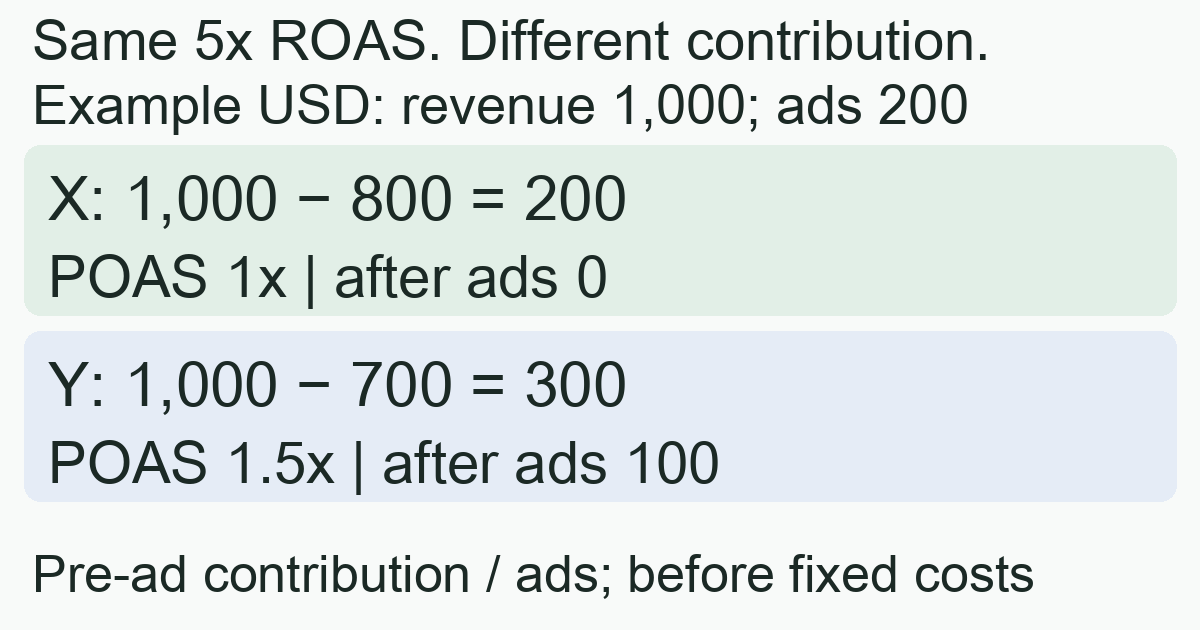
This does not make Y an automatic scaling winner. Inventory, available traffic, returns and the next orders' product mix can change the economics. Marginal ROAS addresses the next budget step; this calculation first reconciles costs for outcomes already acquired.
Does POAS of 1 mean the business is profitable?
On our basis, 1x means C equals A, leaving zero contribution after advertising. It covers the listed variable costs and ads only. If Y also receives USD 120 of allocated fixed expenses, its result at that layer is 300 − 200 − 120 = −USD 20. Even 1.5x would not cover that allocation. There is no universal passing multiple.
Do not first subtract Y's advertising, calculate 100 ÷ 200 = 0.5, and label it the same POAS. That is another ratio: the after-ad remainder relative to advertising. Our definition breaks even at 1; the latter at 0. Show C, A and C − A directly when reconciling competing reports.
Break-even ROAS asks what revenue multiple a cost structure requires. POAS places the contribution from the selected orders beside advertising spend. They can cross-check one another without replacing the company's complete income statement.
Reconcile the ledger before judging performance
- Fix the population. Record the campaign, currency, timezone, click period and attribution window. All revenue this week divided by one source's spending last week is not a matched comparison.
- Align the revenue basis. Do not deduct a discount or refund again as an expense if R already excludes it. After a refund, check which product, shipping and payment costs were actually recovered. Revisit the calculation when late refunds arrive.
- Attach the actual costs. Product, discount and fulfillment mixes can have different costs. Sum the amounts before calculating overall POAS; do not average product multiples. Missing costs are unknown, not zero.
- Keep maturity and coverage visible. Flag outcomes, costs or refunds that have not arrived. Profit covering only some orders cannot be divided by all advertising spend and presented as complete; reconcile both scopes first.
- Choose one verifiable intervention. A fulfillment-cost gap calls for checking product and delivery mix; a refund gap calls for investigating returns. Better measurement does not itself improve profit. Do not drop legitimate cost categories to beautify a ratio.
Can the figure become a bidding target?
Google's value-based bidding guidance allows supplied values to reflect revenue, profit or other business priorities, provided you can define, measure and connect them to campaigns. Changing the value basis from revenue to contribution does not preserve the meaning of the old revenue-ROAS target. Record the new value basis, configuration and effective time separately.
Nor is Google's product gross-profit column automatically this article's POAS. Merchant Center's product-cost guidance estimates gross profit as revenue less product cost and requires item-level conversion information. That does not establish that fulfillment, payment and return costs listed here have been deducted. Check the inputs before using the result for bidding; renaming a column does not change its contents.
MeetROAS Campaigns and connected downstream events can help connect source traffic with completed outcomes. Its event documentation distinguishes registration and first deposit. An event value or deposit does not automatically become merchant net revenue, product cost or POAS. Destination and finance records still need to supply this ledger; this does not imply automatic profit imports into Google Ads.
Sources
- Product Metrics: Profit on ad spend definition — Checked: 2026-11-02
- Shopify: Contribution Format Income Statement — Checked: 2026-11-02
- Google Ads: Value-based Bidding Best Practices — Checked: 2026-11-02
- Google Merchant Center: Cost of goods sold — Checked: 2026-11-02
- MeetROAS: Partner Event API reference — Checked: 2026-11-02