What does CPM measure?
CPM means cost per thousand ad impressions: ad spend / corresponding impressions × 1,000. Spending USD 120 on 20,000 impressions produces a USD 6 CPM. It answers “What did a thousand impressions cost?” It does not tell you how many people paid attention or what acquiring a customer cost.
Google's reporting reference gives this formula, while the Google Ads CPM definition describes bidding per thousand impressions. Separate those uses: CPM can describe a billing or bidding method, or an observed performance metric. Even when charged per click, you can calculate effective cost per thousand impressions. That average is neither a supplier's quoted CPM nor your maximum bid.
Use impressions from the corresponding ad report. Impressions are not landing-page views or unique people: repeated exposure to one person can produce multiple impressions. Dividing spend by website visits does not produce an ad CPM.
Twice the impressions, half the registrations
This is hypothetical teaching data, not customer results. Two campaigns each spend USD 120 promoting the same product and page, aiming for completed registrations. Assume the same currency, time zone, and one-week delivery period. All registrations come from these ad clicks under the same seven-day click attribution window. Compare only after the last day's clicks have completed that window. Each person registers once, each click receives at most one registration, and no view-through attribution or other goal is included.
| Metric | Campaign A | Campaign B |
|---|---|---|
| Ad spend | USD 120 | USD 120 |
| Ad impressions | 20,000 | 40,000 |
| CPM | 120 / 20,000 × 1,000 = USD 6 | 120 / 40,000 × 1,000 = USD 3 |
| Ad clicks | 400 | 400 |
| Click-through rate (clicks / impressions) | 2% | 1% |
| Average CPC (spend / clicks) | USD 0.30 | USD 0.30 |
| Completed registrations | 20 | 10 |
| Click-to-registration rate | 5% | 2.5% |
| Registration CPA (spend / registrations) | USD 6 | USD 12 |
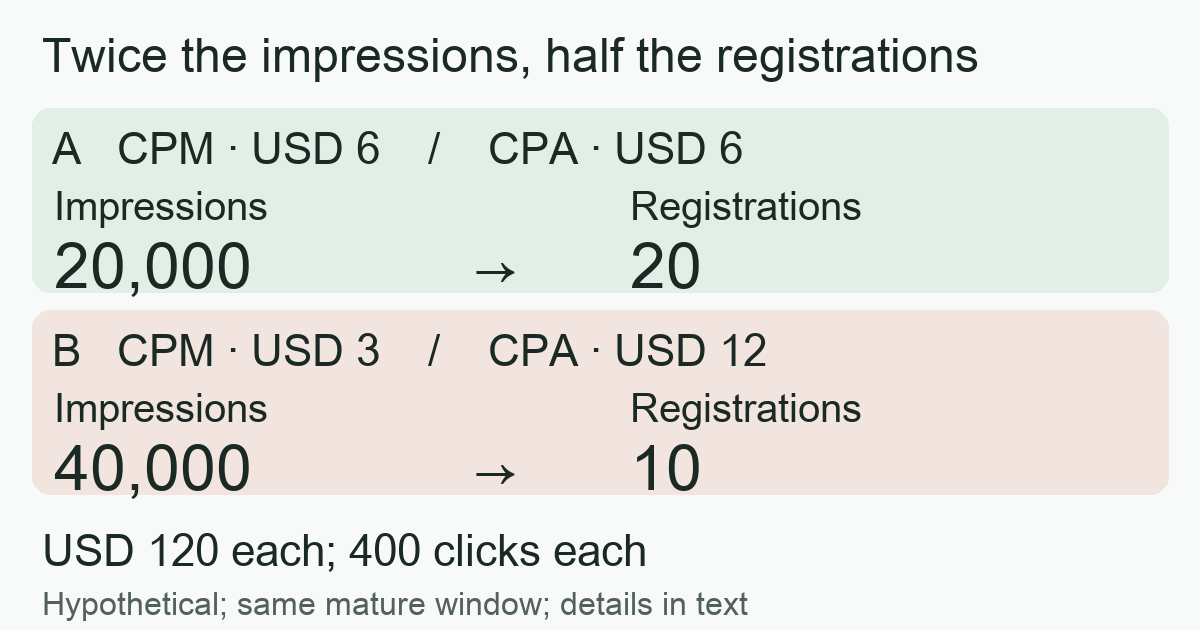
B's CPM is half as high, buying twice the impressions for the same budget, but no additional clicks. A smaller share of clicks also completes registration, doubling registration cost. CPC measures click cost, while CPA measures the cost of a specified action. Each answers a different question along the journey.
These numbers identify questions to investigate. They do not prove that cheap impressions cause poor quality, or that 20 versus 10 registrations establishes a stable winner. Audience, placement, creative, and tracking completeness could affect results. For a registration goal, investigate why a smaller share of impressions leads to clicks and a smaller share of clicks leads to registration before expanding B.
To separate the share of impressions that produces clicks from the share of clicks that completes a goal, read CTR and post-click performance. A higher click-through rate does not guarantee more completed outcomes; examine both stages.
An impression is not proof of attention
A counted impression does not establish that a person saw the ad. An ad may sit below the part of a page a visitor reaches. Google's Active View documentation separates measurable, viewable, and non-measurable impressions. Viewable means meeting an on-screen area and duration standard; it still cannot guarantee someone was looking at the screen.
The standard depends on format. That document's regular display-ad threshold is at least 50% of its area visible for one second. Large display ads have a different area threshold, and video has a different duration requirement. Check format and platform definitions instead of applying one threshold to every impression.
vCPM measures cost per thousand viewable impressions. Its impression scope differs from ordinary CPM, so a lower number alone does not make one offer cheaper. Active View viewability rate also uses measurable impressions as its denominator, rather than all impressions. Suppose 10,000 total impressions include 8,000 measurable impressions and 4,000 viewable ones. Viewability is 50%, and measurability is 80%. The remaining 2,000 are unmeasurable, rather than proven unseen. These figures are hypothetical too.
Three comparison mistakes
Averaging CPMs with different volumes. Suppose A spends USD 10 on 1,000 impressions and B spends USD 90 on 30,000. Their CPMs are USD 10 and USD 3. Combined CPM is 100 / 31,000 × 1,000, about USD 3.23. Averaging the two into USD 6.50 ignores impression volume. Align currency and cost scope first.
Treating low CPM as success for every goal. A brand campaign still needs relevant audiences, reach, and opportunities to see the ad. An acquisition campaign needs completed-goal cost and downstream quality. Many repeated impressions do not mean that many new customers, and there is no universal good-CPM threshold.
Replacing missing data with zero. Zero impressions makes CPM undefined. Missing supplier spend or impression reports means insufficient data. Zero registrations makes CPA undefined, rather than free acquisition. Check delayed reporting or tracking gaps before judging delivery.
What should a media buyer check next?
- Write down the goal. Is it more viewable opportunities among relevant audiences, or completed registrations? Choose the outcome before choosing metrics.
- Collect aligned raw totals. Get spend, impressions, clicks, and available viewability data from the ad platform, and completed events from the destination. Align currency, time zone, event counting, and attribution windows; allow conversions to mature.
- Compare the stages together. Show CPM, click-through rate, CPC, click-to-goal conversion rate, and CPA. If impressions become cheaper but click-through rate falls, inspect audience, placement, and creative. If clicks arrive but completions fall, inspect page experience, message match, and event delivery.
- Validate, then test one change. Reconcile against destination completion records to exclude missing events. Test one explanation with a small budget, such as changing only the creative. Keep the goal and counting rules stable, wait for enough mature outcomes, and avoid treating correlation as causation.
For following acquired traffic through arrival, registration, or first deposit, MeetROAS campaign pages and connected downstream events can help observe that path. Its event documentation defines completed outcomes that the destination must send. Ad impressions and viewability still come from the ad platform; page views cannot replace them.
Frequently asked questions
Should I increase budget when CPM falls?
First check whether the intended outcome improved. A rising mature CPA for an acquisition goal does not justify expansion solely because impressions cost less. For brand exposure, check viewable opportunities, relevant audiences, and reach rather than chasing total impressions.
Why check CPM when paying per click?
CPM shows the cost corresponding to a thousand impressions, while CPC shows cost per click. Together they help identify changes in exposure volume and click response. Use actual spend and counts from the same scope, and label the original billing method.
Sources
- Google Authorized Buyers: Review metrics and dimensions — Checked: 2026-10-13
- Google Ads: Cost-per-thousand impressions (CPM): Definition — Checked: 2026-10-13
- Google Ads: Understanding viewability and Active View reporting metrics — Checked: 2026-10-13
- MeetROAS Developer Hub: Partner Event API and event catalog — Checked: 2026-10-13