UTM labels the campaign; a click ID links a recorded interaction
UTM parameters describe where traffic came from. A click ID is a system-issued reference used to connect a recorded advertising interaction with later events. Two visits can carry identical campaign labels while their later orders need different linkage. Neither a label nor an identifier proves that an ad caused a purchase.
Imagine promoting one course through a partner's article. The buyer can recognize the partner in a source report, but the destination's sale never appears against the expected interaction. Adding more words to the campaign name will not repair a missing identifier. First separate source naming from the path that connects the outcome.
What does each value tell the buyer?
| Value | Who supplies it? | What it helps answer |
|---|---|---|
| UTM source, medium and campaign | The marketer or the advertising platform's naming template | Which sender, marketing method and promotion does this traffic belong to? |
| A system's click ID | The advertising or tracking system that issues it | Which recorded interaction can this later event be matched to? |
| An order or event identifier | The destination's business system | Which business fact is being recorded, including when a delivery is retried? |
Google's UTM guidance describes campaign labels. Our UTM naming lesson shows how to build consistent links. The distinction is not that UTM reports can never contain conversions: Analytics can attribute outcomes using its collection, identity and attribution mechanisms. The labels alone are not the complete matching mechanism.
GCLID is a particular Google identifier, not a universal name for every tracker token. Google's auto-tagging documentation explains that it is appended to the destination URL. It also notes that a GCLID can sometimes originate at impression time and be reused for repeated clicks. Do not assume one distinct identifier equals one physical click or one person.
Two campaign records, one known USD 50 sale
This is a fictional tracker example for one completed seven-day UTC period. Assume two recorded acquisition interactions, A and B, and one accepted course order worth USD 50 in the destination ledger. These are records, not a count of distinct people. The short tokens below are teaching placeholders, not valid Google or product credentials.
| Recorded interaction | Campaign labels | Tracker reference |
|---|---|---|
| A | partner / referral / intro_course_202611 | demo-a |
| B | partner / referral / intro_course_202611 | demo-b |
In the first scenario, the destination retained demo-b with the order and returned it through the supported event integration. The tracker can match that order to record B. There is still only one USD 50 order; matching it does not create a second sale or establish causality.
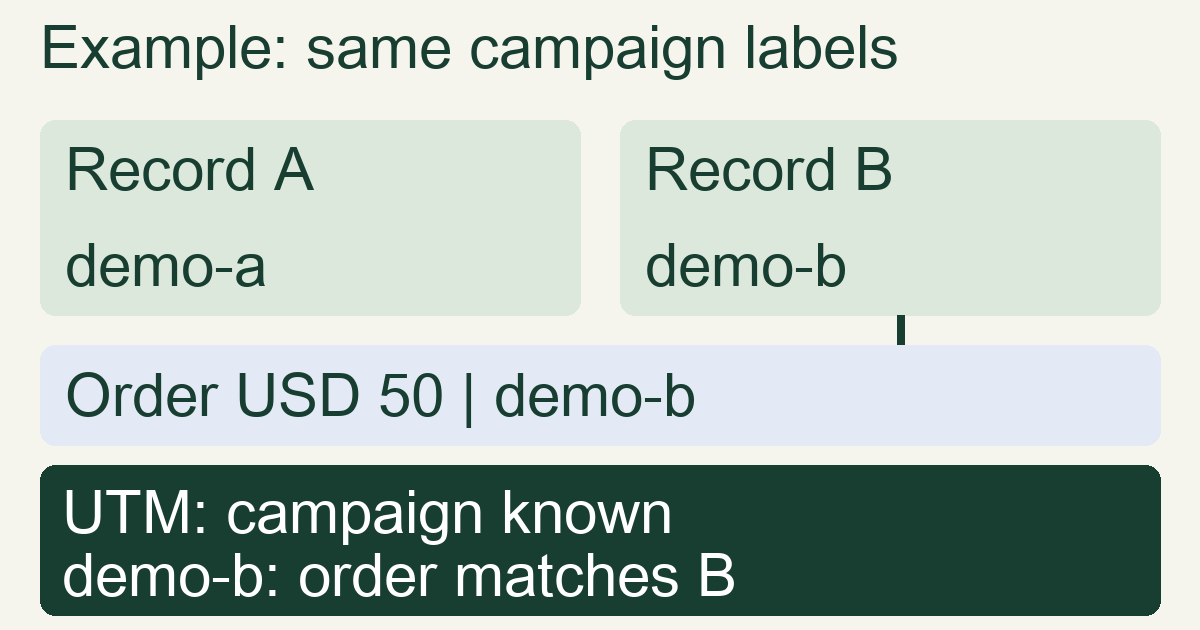
Now consider an alternative scenario for the same order: a redirect dropped the reference before the destination stored it. The campaign labels still identify the shared promotion, but cannot by themselves select A or B. The business ledger still has USD 50. The missing value is the link to the interaction, not proof of zero revenue. Do not add these two scenarios as separate orders.
Preserve the issued value through the real journey
The practical handoff has three jobs: receive the reference, retain it with the relevant destination record, and return it with the actual outcome. A field appearing in a landing-page address verifies only the first part.
For Google Ads' GCLID-based offline import, Google's setup guidance requires capture and storage with the corresponding prospect. It says the value is case sensitive. Use the current documented integration for your data source; do not manufacture an identifier, lowercase it, or replace it with one fixed campaign value. A GCLID and a separate tracker's reference belong to different systems and are not interchangeable.
Ask whoever manages the destination to check the route actually used: advertisement, any shortener or redirect, landing page, form or checkout, and the system that sends the outcome. Where an integration creates its own reference, preserve the documented mapping between identifiers rather than guessing that similarly named fields contain the same value.
Diagnose the missing link before judging traffic quality
Check the evidence in order:
- Arrival: Did the intended destination receive the correct parameter and its original value after redirects? A source label surviving does not establish that the reference survived too.
- Retention: Was that value attached to the lead or order that later completed, rather than merely visible on the first page?
- Outcome delivery: Did the correct receiving account accept the intended registration or payment event? Pressing a purchase button or sending a request does not itself prove acceptance.
- Report scope: After processing, compare the same event, currency, time basis and eligible window. See attribution windows when a correctly linked event is outside a report's rules.
Browser restrictions, consent choices, cross-device journeys and unsupported integrations can limit linkage. A missing ID is one possible explanation for a discrepancy, not a diagnosis of every missing conversion. A click reference also does not replace an order ID: registration and payment can relate to the same interaction while remaining different business facts.
Test safely, then compare actual outcomes
Before relying on a new placement, arrange a documented test with the destination team. Keep the campaign labels stable, verify one permitted test reference through the real route, and check the recorded outcome and receiver's response. Use the platform's test procedure and separate its results from production performance. Never copy an old visitor's identifier into everyone's URL to make a test appear to work.
Keep names, email addresses and phone numbers out of UTM values; Google's PII guidance covers campaign parameters. A technical-looking token is not automatic proof of anonymity or permission to collect data. Limit access to test evidence and avoid exposing identifiers in shared screenshots.
MeetROAS connects Campaign traffic with integrated destination outcomes through its documented Click ID handoff: the destination must retain and return the actual issued value. This can help a buyer locate where traffic stops progressing, but requires the destination integration; it does not automatically import Google Ads offline conversions. Verify the connection, then compare completed funnel outcomes before treating an unmatched sale as poor traffic.
Sources
- Google Analytics: URL builders — Checked: 2026-11-01
- Google Ads: About auto-tagging — Checked: 2026-11-01
- Google Ads: Set up offline conversions using GCLID — Checked: 2026-11-01
- Google Analytics: Avoid sending personally identifiable information — Checked: 2026-11-01
- MeetROAS: Partner Event API reference — Checked: 2026-11-01