What does attribution actually allocate?
Ad attribution answers: “Which interaction should this report credit for a purchase or registration?” It assigns an observed outcome to touchpoints before that outcome using a rule or model. An order and the allocation of credit are separate things. Changing the model can change a channel's reported performance without creating another order.
Imagine a customer clicks a social ad, then a search ad several days later, and pays. Both platforms report a purchase. Before adding their revenue or turning either channel off, establish which part of the journey each report observed and which rules it applied.
A touchpoint is a recorded interaction, such as an ad click. A conversion is the business outcome you select, such as a completed payment. An attribution model decides how credit is allocated. Google Analytics calls important actions key events and describes attribution as assigning credit through rules or a data model.
One USD 100 order, three ways to assign credit
This is a hypothetical example, not customer results. One customer clicks Ad A on day 1, clicks Ad B on day 3, and completes one USD 100 payment on day 5. Assume one report can connect both clicks, both qualify within its window, and there are no other touchpoints, refunds, tax, or shipping charges.
| Illustrative rule | Credit to A | Credit to B | What does it emphasize? |
|---|---|---|---|
| First click | USD 100 | USD 0 | Which source first brought the customer in? |
| Last click | USD 0 | USD 100 | Which source supplied the final click before purchase? |
| Equal split | USD 50 | USD 50 | Giving each of the two clicks half the credit |
Each row allocates USD 100. These are alternative views, not USD 300 of revenue to add together. Adobe's attribution components distinguish the model from its lookback window: decide which interactions qualify, then allocate credit.
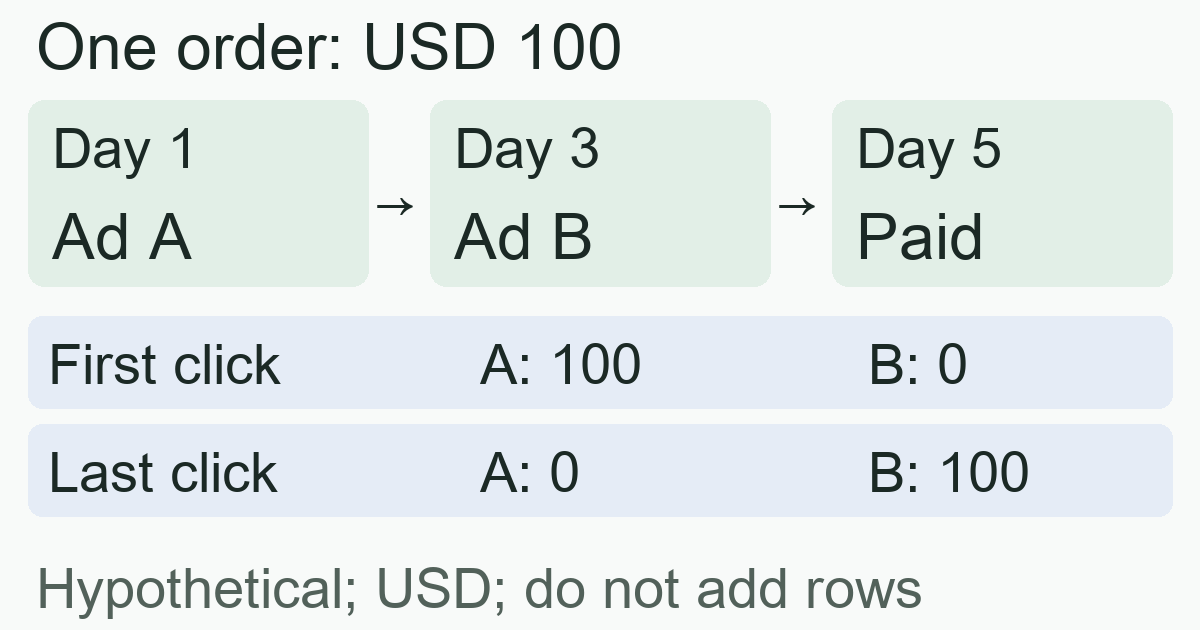
Zero last-click credit for A does not mean A never reached the customer. Full credit for B does not establish that the customer would never have bought without B. An equal split is easy to understand; it does not demonstrate that each click caused half the purchase intent.
Windows determine eligibility; models determine allocation
A window asks how far back an interaction can qualify. A model asks how qualifying interactions share credit. Keep these settings separate.
In our example, all interactions occur at the same time of day in one timezone. A is four days before payment; B is two days before payment. An illustrative three-day click window excludes A and includes B. A seven-day window lets both qualify. Check your platform's exact boundaries and click/view rules; these are examples, not recommended settings.
Google Ads' conversion-window documentation explains how a window limits the time after an ad interaction during which a conversion is recorded. A shorter window can exclude later purchases; a longer one can make earlier interactions eligible. Neither creates orders. Also allow time for customers to pay and for events to reach the report before judging today's traffic.
For a practical duration decision, continue with choosing an attribution window, including click/view rules and incomplete observation periods.
Current Google options differ from textbook examples
First click and equal splitting above explain concepts. In the current Google Ads documentation, first click, linear, time decay, and position-based models are no longer supported. Current options include last click and data-driven attribution. Avoid following an old tutorial to find a retired setting.
Data-driven attribution uses historical data for the conversion action to allocate credit. It is not a fixed equal split, and you cannot calculate its actual weights from one customer's three timestamps. A model change can also affect automated bidding that uses those conversion data. Compare models, record the change, and observe mature outcomes before drawing conclusions.
Check eligible channels as well. Google Analytics' attribution reports list data-driven, paid and organic last click, and Google paid channels last click. The name “last click” does not guarantee the same channel coverage across tools. These GA4 models generally exclude direct visits from credit unless the whole journey is direct. Verify the current documentation and your account's settings.
Five checks when reports disagree
- Align the outcome. Is each report counting completed payment? Registration is different. Assigned, paid, and after-refund amounts also differ; see conversion value versus revenue.
- Align windows and interactions. A report accepting view-through conversions can differ from one accepting clicks alone. Write down the actual settings, not just “seven days.”
- Align models and channels. Are both last click? Do both include organic search? Compare allocations on the same observable journey to distinguish a rule difference from missing data.
- Align dates and money. Match timezone, click-date versus conversion-date reporting, currency, and refunds. Allow reporting delays, then reconcile totals against one deduplicated order ledger in the destination system.
- Check linkage. Device changes, consent settings, or lost source information can leave a tool with only part of the journey. Label an unlinked source as unattributed rather than assigning a guessed channel or zero revenue.
GA4 also has user-, session-, and event-scoped traffic-source dimensions. First user source describes initial user acquisition; event attribution describes credit for a particular key event. Similar labels do not make these interchangeable reconciliation views.
Use consistent UTM source naming to label acquisition links before comparing their attributed outcomes.
MeetROAS can help connect Campaign landing pages with integrated downstream events, separating installation, first open, and payment goals to locate drop-off. Payments still require destination-system event delivery and valid source linkage. This helps answer how far traffic from a source progressed; it should not be treated as a complete cross-platform multi-touch model or incrementality proof. The event documentation describes the integration boundaries.
How should a marketer act on attribution?
Choose a stable primary reporting basis, alongside the cost and revenue checks for ROAS. Use it consistently across creatives, sources, and mature cohorts. Switching from one platform's attributed revenue today to another tool's rules tomorrow does not establish improvement.
If A frequently appears at the start but rarely gets last-click credit, investigate the hypothesis that it introduces new customers. Examine new-customer share, subsequent journeys, and a controlled test. If B often appears immediately before payment, investigate whether it captures existing demand. These are questions to validate, not automatic instructions to move budget. Do not change models simply to improve a channel's reported numbers.
Credit is different from additional purchases
Attribution allocates observed outcomes. An incrementality experiment asks how many purchases would be missing without the ads. Consider a properly randomized study with 1,000 eligible people in each arm over the same period: 60 payments in the ad arm and 50 in the control arm. The observed difference is 10, not all 60 payments. This is arithmetic illustration only. Assess balance, interference, delays, and uncertainty intervals before treating the difference as established causal evidence.
Google's Conversion Lift uses treatment and control groups to measure incrementality and is not available to every account. Make routine event, cost, and attribution reporting reliable first. When the decision becomes whether to increase a channel's budget, choose an appropriate incrementality experiment instead of asking a credit-allocation report to prove that decision alone.
Sources
- Google Analytics: Get started with attribution — Checked: 2026-10-18
- Adobe Analytics: Attribution components — Checked: 2026-10-18
- Google Ads: About conversion windows — Checked: 2026-10-18
- Google Ads: About attribution models — Checked: 2026-10-18
- Google Analytics: Scopes of traffic-source dimensions — Checked: 2026-10-18
- Google Ads: About Conversion Lift — Checked: 2026-10-18
- MeetROAS: Partner Event API reference — Checked: 2026-10-18