What is conversion delay, and why does it change ROAS?
Conversion delay is the time between an ad interaction and the outcome you measure. A visitor may click today and pay days later. Reporting can take additional time after payment. When spend is already visible but outcomes are incomplete, recent CPA can look too high and ROAS too low. A poor early ratio is a reason to investigate, not proof that late revenue will rescue the campaign.
A cohort means a fixed group, such as the people who clicked a campaign during one acquisition day. Keep its advertising cost fixed and revisit the outcomes credited to that group. This answers a different question from “How much did customers pay today?” For the basic ratio and value definitions, see what ROAS measures.
Google's conversion-lag guidance describes incomplete recent CPA and ROAS and distinguishes forecasts from observed reporting. This guide explains how to build a comparable review sheet, rather than how to choose an attribution window.
A 0.5x result can be incomplete without being a forecast of 2x
This example is entirely hypothetical. Two separate acquisition cohorts each cost USD 100, with final spend already reconciled. Count distinct paid orders once, each worth USD 50, under the same click-only attribution policy. Assume complete order matching and delivery at each checkpoint, one currency, and no refunds, tax or shipping in these initial amounts. Checkpoints measure full elapsed days after each cohort's final ad click; the cohorts have the same within-day click pattern.
Older cohort A has eight full observation days. Newer cohort B has only one. Cumulative observed results are:
| Checkpoint | A: value / ROAS | B: value / ROAS |
|---|---|---|
| After 1 day | USD 50 / 0.5x | USD 50 / 0.5x |
| After 3 days | USD 150 / 1.5x | Not yet observed |
| After 7 days | USD 200 / 2x | Not yet observed |
At their latest cutoffs, A has four orders and B has one. Comparing A's 2x with B's 0.5x mixes different observation lengths. At the common one-day checkpoint, both show one order, 0.5x ROAS and USD 100 CPA. That establishes equal observed first-day results, not equal eventual quality or a statistically reliable tie.
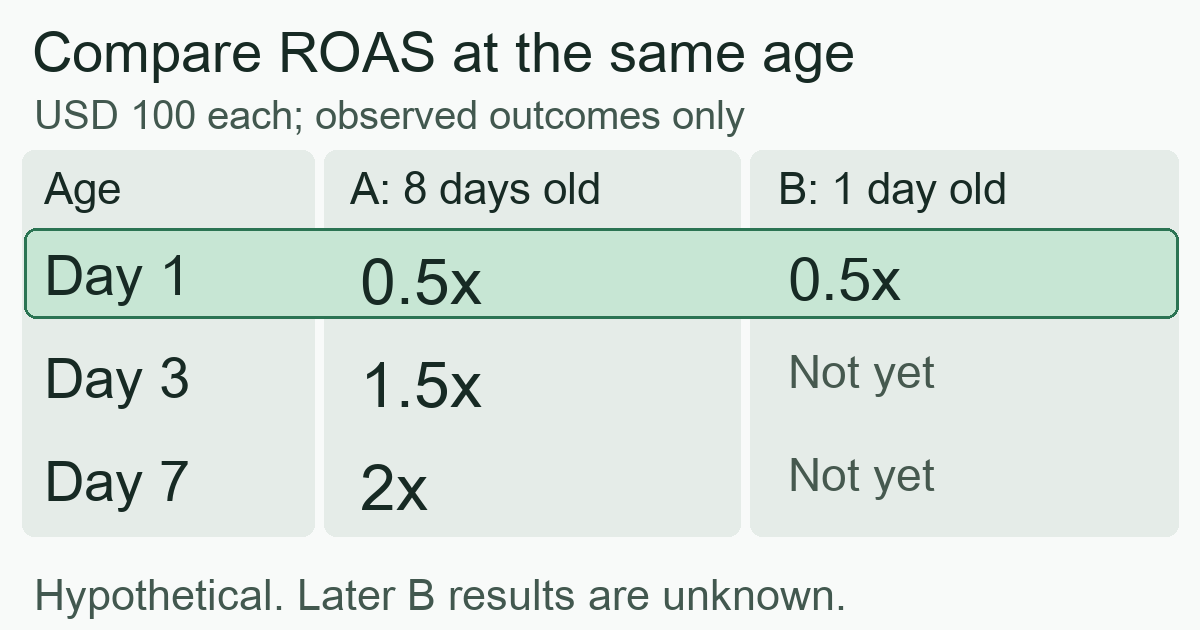
For A at day seven, ROAS = USD 200 / USD 100 = 2x, and order CPA is USD 100 / 4 = USD 25. B's later cells remain unknown. Do not copy A's later results into B, count a not-yet-reached checkpoint as zero, or use today's payments from unrelated cohorts to fill it. Seven days is a teaching horizon, not a universal maturity rule. Even A's seven-day result can change later.
Separate customer delay, reporting delay and date basis
Record three timestamps for a legally retained, matched example: the ad interaction, the completed business event, and the time it became visible in the report. A September 1 click, September 4 payment and September 5 report appearance imply three days of customer delay plus another day before reporting. All dates here use UTC; use an agreed timezone in your own worksheet.
A payment still waiting to happen is different from a payment already recorded by the destination but missing from the advertising report. The latter calls for checking delivery, matching, eligibility and processing. Waiting longer cannot repair a missing integration automatically.
Google's conversion-time documentation distinguishes standard click-time conversion columns from columns based on when conversion occurred. A September 4 payment can update the September 1 click cohort while appearing on September 4 in a conversion-time view. Neither date changes the customer's journey.
Use the acquisition cohort's spend for acquisition ROAS. Dividing all payments received today by today's spend can mix past and present customers. For a broader investigation across tools, use the ROAS report reconciliation worksheet; do not change attribution settings merely to make reports agree.
Choose a review cutoff from mature evidence
Start with older, comparable cohorts whose selected conversion window has elapsed and whose expected reporting delivery is complete. Google's Days to conversion instructions ask for a reporting period ending at least 30 days ago, or longer for a longer window. That is guidance for obtaining complete history, not a command to wait exactly 30 days before every decision.
For each historical cohort, record cumulative observed counts and value at consistent checkpoints. A handful of late large orders can shift value more than order count. A short recording window also hides excluded later outcomes: a seven-day report cannot prove customers never buy on day nine. Keep the attribution-window policy separate from the observation cutoff.
If complete history shows USD 900 of USD 1,000 in thirty-day value by day seven, day seven covers 90% of that observed thirty-day value for that historical sample. It does not establish lifetime completeness. Nor does it justify multiplying a new campaign's early value by 1 / 0.9: creative, audience, product mix and reporting coverage may differ. With sparse or changed data, label the forecast unavailable and schedule another observed checkpoint.
Maturity does not mean value can only increase
Later purchases can add value, but cancellations and refunds can reduce it. Suppose one of A's four USD 50 orders is later fully refunded. Under a refund-adjusted revenue policy, the revised amount is USD 150 and the corresponding ratio is 1.5x, without any change to its USD 100 spend. Keep gross orders, retained orders and the adjustment date separate; do not silently relabel the original gross figure as net revenue.
Google's conversion-adjustment documentation explains restating or retracting supported conversions. Availability and timing depend on the conversion setup. A refund in the business system does not prove every advertising tool has received the correction. Observed value, forecast value and later adjusted value need separate labels.
Decide what to do now, and what to revisit
Create one review record with the cohort dates, timezone, spend status, outcome definition, currency, attribution policy, observation age and last completed data delivery. Include the common-age comparison, unmatched or pending records, and the next review checkpoint. Record the decision before looking for a favorable later ratio.
- Delivery is incomplete: inspect a small matched sample and resolve the missing or rejected records. Keep unavailable outcomes distinct from confirmed zero orders; CPA with zero orders is undefined.
- The cohort is young but tracking works: compare equal observation ages and maintain a predefined spend cap. Use early signals to investigate, while reserving the final purchase judgment for its scheduled checkpoint.
- Comparable mature cohorts remain weak: investigate the offer, audience and landing experience; choose one bounded test. More waiting alone is not a strategy, and complete tracking does not prove advertising caused the orders.
Pause or contain spend immediately when a verified destination outage, broken payment flow or budget breach requires it. Conversion delay is no reason to ignore an operational defect, and no formula makes a small sample decisive.
MeetROAS can help separate installation, first open and connected downstream events when investigating where results stop appearing. Destination outcomes still need valid event delivery and linkage; installs are not payment revenue. Use the event integration reference to establish coverage, then retain the destination's business ledger for order and refund reconciliation. This does not imply automatic delay forecasting or refund synchronization.
Sources
- Google Ads: About conversion lag reporting — Checked: 2026-10-24
- Google Ads: Find out how long it takes for customers to convert — Checked: 2026-10-24
- Google Ads: Understand conversion tracking data — Checked: 2026-10-24
- Google Ads: About conversion adjustments — Checked: 2026-10-24
- MeetROAS: Partner Event API reference — Checked: 2026-10-24