Two paid orders in your store, but three purchase conversions in the advertising report: start with which order reached which conversion action, not a change to your budget. A duplicate conversion means the same completed outcome has been represented more than once in the population you are counting. A repeat purchase is a different order and should not disappear with it.
A transaction ID identifies the order. An event is a message describing an outcome; a retry sends that message again. A conversion action is the destination category configured in Google Ads, such as a particular purchase action. Deduplication means recognizing repeated representations of the same outcome within a defined scope. One identifier does not automatically merge every system or every action.
First separate a duplicate from a different report
Seeing one purchase in GA4 and one in Google Ads is not, by itself, proof of duplicate tracking. They are separate reporting views. Adding their totals would not give you two unique orders. Likewise, two different orders from one buyer are two purchases, not duplicate messages.
Start with the same completed outcome, currency, timezone, date basis and conversion action. Use a mature period, allowing for conversion delay. An event count, a key-event count, attributed credit and unique buyers also answer different questions. If your problem is one eligible click producing several genuine purchases, use the separate One versus Every guide; changing Count is not a repair for duplicate wiring.
A gap between order totals and an ad report is a reason to investigate, not a rule that those totals must match. Attribution eligibility, windows and missing signals can produce legitimate differences.
Worked audit: four deliveries, two orders, two destinations
This hypothetical example is not customer results. Your store has two completed orders: A for USD 100 and B for USD 60. There are no refunds, taxes or shipping charges. Assume both orders are eligible, fully credited and mature, with purchase actions using Every. These assumptions deliberately remove timing and attribution complications.
| Order | Delivery | Action | ID |
|---|---|---|---|
| A | Tag | Buy-A | A |
| A | Retry | Buy-A | A |
| A | Import | Buy-B | A |
| B | Tag | Buy-A | B |
Read the table by order, not just by row. The retry is another delivery of A to Buy-A. If the action's transaction-ID deduplication works, Buy-A records two orders and USD 160. But a second configured action, Buy-B, also represents A. If your report includes both actions, their sum can be three purchases and USD 260, although the store has only two orders and USD 160.
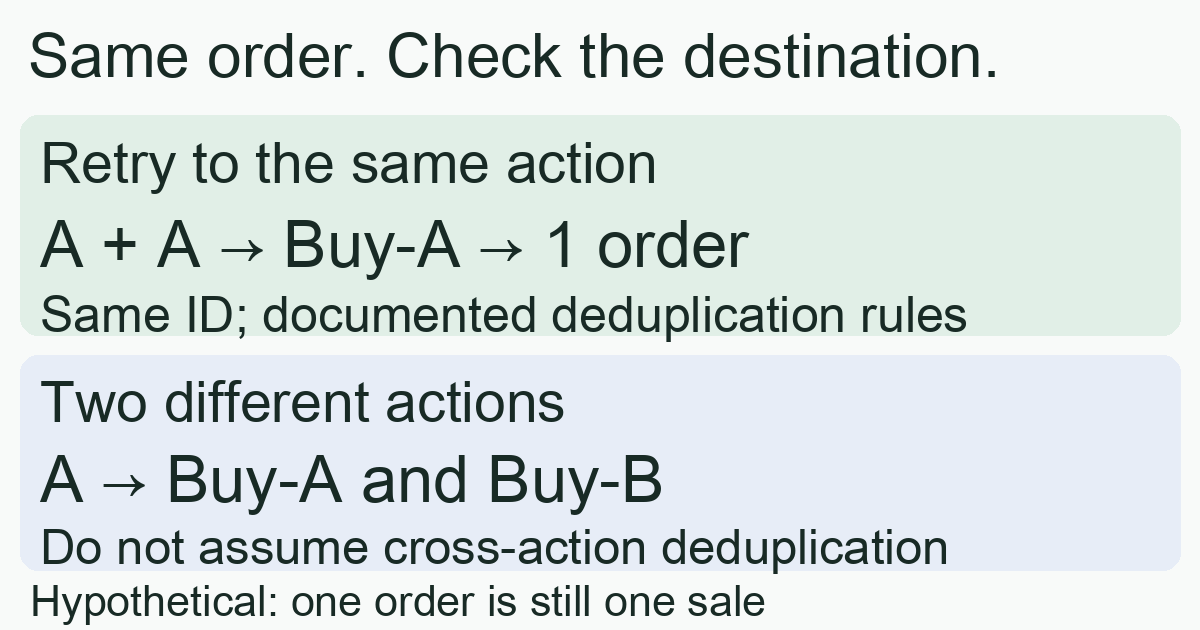
The extra USD 100 is not new revenue. It is A represented in two destinations. This is an illustrative setup, not a prediction for every import method. The important diagnostic is whether two actions describe the same completed purchase and are both included in the report or bidding goals.
Same-action retry and two-action duplication need different fixes
Google Ads transaction-ID guidance describes duplicate recognition for the same conversion action and transaction ID. In the example, preserve A when resending A; use B for the other order. Generating a new ID on each confirmation-page reload defeats that relationship. Reusing one fixed ID for unrelated orders can suppress real purchases.
Now inspect the destination. Google explicitly says its multi-source conversions beta deduplicates within the linked action, not against other actions. Availability and supported sources are limited, so this is not an instruction to enable the beta or assume every integration uses it. It illustrates why “both messages have the same order ID” is insufficient when their destinations differ.
For two overlapping purchase actions, document their purposes, sources and campaign goal participation before changing anything. Decide which action should represent the outcome for the intended report and optimization. Do not delete all secondary measurement merely to make a total smaller. A diagnostic action can remain useful when you keep its population separate.
Check GA4 purchase identity without hiding real orders
In GA4, inspect actual purchase messages and their transaction_id. Google's GA4 guidance describes purchase deduplication using the same transaction ID from the same user. It does not promise that an arbitrary event_id deduplicates all event types or all collection paths.
Keep the order ID stable across repeated delivery of that purchase, and distinct for another order. Do not reuse it across different users. Google warns that an empty string can collapse purchase events and that a fixed ID can undercount. A lower total after a change is therefore not enough to call the fix successful.
Keep personal information out of these identifiers. Confirm the actual value sent, rather than relying on a screenshot of a tag variable's name. Check whether a store integration and a manually added tag both send the same outcome; their presence is a hypothesis to test, not proof that every dual-source setup double counts.
A practical repair and acceptance checklist
- Choose a small known sample. Use authorized test orders or appropriately restricted records. Record completed status, order ID, amount and currency. Do not export customer details into a shared troubleshooting sheet.
- List each delivery path. Note source, destination property or action, outcome name, occurrence time and identifier. Look for page reloads, duplicate tags, imports and retries. Preserve the original record while diagnosing.
- Classify the discrepancy. One order delivered repeatedly to one action suggests firing or identity handling; one order in two overlapping actions suggests destination and goal configuration; two different orders require distinct identities.
- Repair the proven cause. Correct the firing condition, stable order identity or overlapping configuration. For retries, follow that integration's documented contract and preserve the original event fields, not merely one ID while changing the timestamp or amount.
- Verify both sides. In an authorized test, deliver one outcome twice and then a second genuine outcome. Confirm the repeated delivery is recognized within the documented scope while the second order remains. Inspect the tag/event details, destination diagnostics and the later mature report; an HTTP success alone does not prove correct accounting.
Log the change time and compare like-for-like periods. If historical data needs correction, use the platform's supported adjustment procedure separately; changing future delivery does not establish that old reports were repaired. Fixing duplication can reduce reported conversions or ROAS without reducing actual sales. The success criterion is a traceable representation of real outcomes, not a higher metric.
For connected destination events, MeetROAS's event contract provides stable retry identity and distinct IDs for repeatable transactions. It helps teams agree what the destination reported before interpreting performance. A destination deposit is not automatically a store purchase; this does not promise order-ledger reconciliation or automatic deduplication across Google Ads actions.
Sources
- Google Analytics: Minimize duplicate key events with transaction IDs — Checked: 2026-11-04
- Google Ads: Use a transaction ID to minimize duplicate conversions — Checked: 2026-11-04
- Google Ads: Multi-source conversions (beta) — Checked: 2026-11-04
- MeetROAS: Partner Event API reference — Checked: 2026-11-04