Message match means keeping the promise after the click
Ad-to-landing-page message match means that the page continues the ad's offer, audience, conditions, and expected next action. A landing page is the first page reached after an ad click. A call to action, or CTA, tells the visitor what to do next. Matching those messages helps a visitor answer: “Is this the offer I clicked, and what happens if I continue?” Repeating a keyword alone does not answer that question.
For example, an ad promising a free 30-minute website audit should lead to a page that explains that audit and how to book it. A generic services page with a purchase button asks the visitor to reconstruct the offer. If the next step actually requires buying a subscription, the problem is the offer itself, not merely the headline.
Google's landing-page guidance recommends aligning the page with the ad's offer and CTA. This is a practical audit, not a promise of a particular conversion lift, Quality Score, ad approval, or organic ranking.
A concrete audit: ad, page, button, and destination
The following is a fictional teaching example, not a MeetROAS service or a customer result. Imagine an agency genuinely offers one free 30-minute audit call for one website, with no purchase required. The call identifies three issues; implementation is a separate paid service. Those are the example's real terms, so both the ad and page must represent them accurately.
- Ad: “Book a free 30-minute website audit.” State material eligibility or availability limits wherever they are needed to avoid a misleading impression; do not save a contradiction for fine print.
- Page: “Book your free 30-minute website audit.” Explain the three-issue review, who it suits, what the visitor needs to provide, and that implementation is separate. A visitor should not need to search a long services catalogue to find the advertised offer.
- CTA: “Choose a time.” This describes opening the booking calendar. It does not claim that a slot is already reserved.
- After the click: Show available times and request only the details needed to arrange the call. Report success after the booking system confirms the reservation. A button click alone is not a confirmed booking.
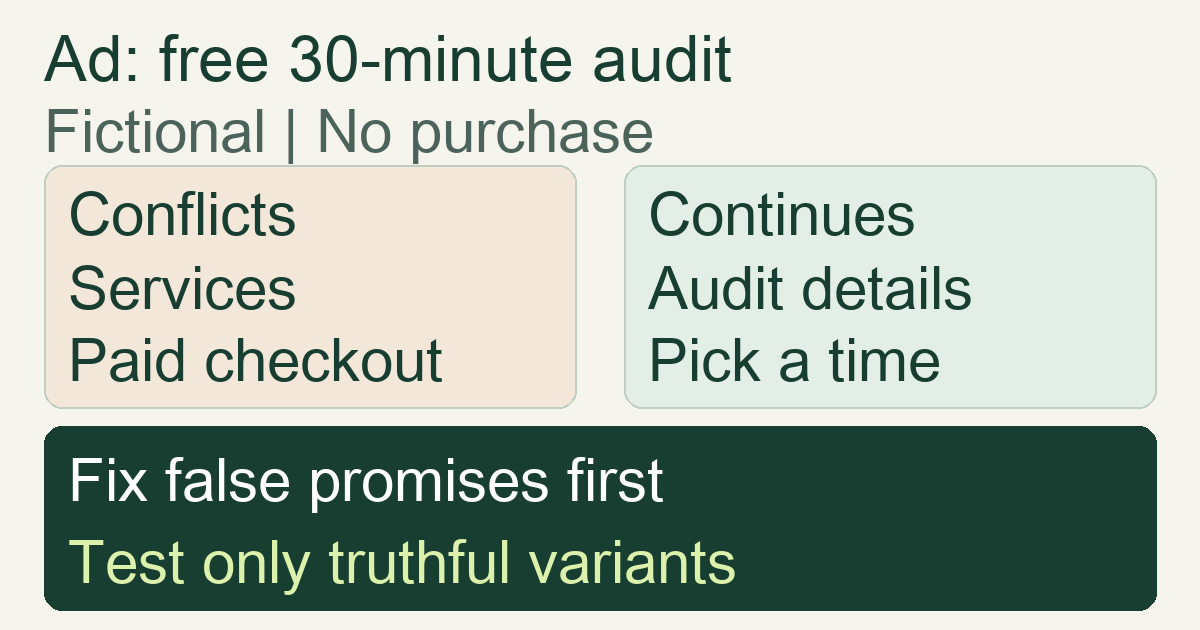
A button saying “Get your audit now” while opening a sales inquiry form sets a different expectation from “Request an audit appointment.” Select wording that describes the actual next step. If the agency only sells paid audits, correct the ad and page to that paid offer; do not paint a free headline over a paid flow.
Correct a misleading journey before testing. Do not deliberately keep a false promise as a control variant. Later comparisons should involve two truthful experiences.
Check five things, rather than just matching words
The offer. Confirm the same product or service, quantity, price basis, and eligibility. “Free consultation” is not interchangeable with “free implementation.” A discount for selected items should not silently become a discount for the entire catalogue.
The intended visitor. An ad aimed at first-time customers should not land on instructions that only work for existing subscribers. If different audiences need different pages, preserve the relevant offer on each route.
The important conditions. Make material limitations clear before commitment. Check required purchases, deadlines, geography, and the meaning of “free.” If a condition cannot be met, update or stop the affected ad rather than conceal the conflict in page copy.
The language and visual cues. Use recognizable product names, imagery, and language so visitors can identify the offer. This does not require identical wording or decorative repetition. Google's Quality Score advice explicitly distinguishes useful relevance from copying a search phrase word for word. Keep that Search diagnostic separate from a universal score for every advertising channel.
The next action. Walk beyond the first button. Check the form, calendar, price, confirmation, and any required account or installation step. An extra step is not automatically wrong, but it must not contradict what the ad and page led someone to expect. Perform the check on the actual mobile route too.
Cheap clicks or extra bookings do not prove the journey improved
Start with a reproducible mismatch, not a diagnosis inferred from one metric. A low CPC describes click cost; it does not establish that the visitor found the promised offer. Slow loading, form errors, audience mix, or missing completion data can also explain weak outcomes. Use the campaign funnel worksheet to locate the step before deciding which explanation to test.
Here is another invented example, not measured uplift. A and B are both truthful audit-booking pages. A uses a general but accurate introduction; B makes the existing free-audit offer more explicit. Each has 500 distinct eligible arrivals during the same acquisition week in Asia/Taipei. Assume complete identity and booking records, one booking and one attended call at most per person, and equal seven-day follow-up after each arrival. Exclude existing clients; count cancellations as unconfirmed. The attendance record is reconciled after the full window.
| Page | Arrivals | Confirmed bookings | Attended calls |
|---|---|---|---|
| A | 500 | 50 | 30 |
| B | 500 | 75 | 30 |
Booking rate is 50 / 500 = 10% for A and 75 / 500 = 15% for B. Attended-call rate is 30 / 500 = 6% for both. More reservations did not produce more attended calls in this example. Whether that outcome is worthwhile also depends on the business goal and costs; neither column proves profit.
These assigned numbers do not demonstrate that clearer copy caused a change or that the difference would persist. A small sample, different traffic mix, or immature follow-up can distort a real comparison. Use consistent conversion-rate denominators, and distinguish confirmed zero results from unavailable measurement.
If the main content seems slow, use the landing-page speed measurement guide to separate lab and field evidence. One test score cannot replace completed outcomes for the same eligible group.
Turn a verified mismatch into one bounded test
- Save the actual route. Record the ad wording, audience, advertised offer, final page, mobile screenshots, CTA destination, and version date. Check materially different served ad combinations, not only a convenient draft.
- Separate broken promises from test ideas. Correct false terms and broken functionality directly. For two honest variants, choose one specific uncertainty, such as whether a clearer description helps visitors understand the booking step.
- Define success first. Name a confirmed business completion and a relevant downstream outcome. Keep the event definition, audience scope, and observation window stable; do not rename a click as a lead.
- Control the comparison. Where a valid random assignment is available, keep other material changes fixed. Without that design, report a descriptive comparison and its limitations. Predefine the test cap and avoid stopping at the first favorable result.
- Recheck the complete journey. Confirm that both versions still deliver the offer and that completion records arrive. Review mature outcomes, costs, and uncertainty before adopting a version. Do not turn a promising small sample into a guaranteed improvement.
MeetROAS can help compare Campaign-page and PWA observations with connected downstream outcomes. Its event reference distinguishes completed registrations and deposits as downstream events. If the goal is an audit booking, verify a genuine booking-completion measurement separately; those events are not substitutes. This does not imply automatic ad-copy auditing or a native booking system.
Common questions
Must the page headline exactly repeat the ad?
No. It must clearly deliver the same truthful offer and expected next step. Several ads can lead to one useful page when that page genuinely serves their promises. Different offers or eligibility may need distinct destinations.
Should every page change increase clickthrough rate?
The landing page is normally seen after the ad click, so the immediate check is what visitors understand and complete afterward. Evaluate the stated business outcome. Neither a more persuasive button nor a higher intermediate completion count establishes better customers or profit.
Sources
- Google Ads: Optimize your ads and landing pages — Checked: 2026-10-28
- Google Ads: 5 ways to use Quality Score to improve your performance — Checked: 2026-10-28
- MeetROAS: Partner Event API reference — Checked: 2026-10-28