Keep the page, change how the visit is recorded
Both Voluum and RedTrack can track visitors who arrive directly on an existing landing page. Voluum's direct campaign separates the ad-to-page transition from the page-to-offer transition. RedTrack's Universal script connects a shared page to generated source parameters and a default campaign. In this scenario the buyer's team supplies and hosts the page. Neither arrival script is a page builder or, by itself, a selector that chooses the first page before it opens.
One buyer advertises a course through two paid channels and also receives untagged visits. The team already hosts the course introduction and enrolment destination. The buyer wants visitors to see that introduction immediately, then wants to identify the channel behind a completed enrolment.
A lander is the introduction page visitors see. An offer is the promoted course and its destination. A CTA, or call to action, is the button that continues from the introduction to enrolment. “Direct” here describes the first transition: the visitor reaches the page without an entry redirect through the tracker. It does not mean tracking is unnecessary or that every later transition must also avoid redirects.
Voluum: choose the two transitions separately
Voluum's direct-method guide starts with a selected traffic source, offer and editable landing page. For our course, the buyer adds the external lander and enrolment offer, then selects Direct for the first transition in the campaign.
The second transition has its own choice: direct or one of the supported redirect modes. The buyer places the generated campaign tracking script on the externally hosted page and implements its onward click URL. The source receives the lander tracking URL from the selected setup. Copy the appropriate generated URL rather than assuming that the page's bare address carries the same tracking information.
This separation answers a common operating question. A visitor can reach the introduction directly, while its enrolment button still follows the configured onward tracking path. Changing the first radio button does not remove the need to verify the CTA. The multi-offer button comparison covers that later step when a page presents several distinct products.
There is also an entry-control tradeoff. Voluum documents that its direct method cannot rotate incoming landers or use rule-based paths and traffic-distribution AI in that described setup, because the visit is reported after arrival. It also specifies an offer-rotation restriction for offer-only direct campaigns. Do not stretch those statements into a claim that every offer transition or every testing feature is unavailable.
RedTrack: choose the script before judging channel data
RedTrack's no-redirect guide describes two script choices. Universal script supports several campaigns and traffic channels on one page and separate paid/organic tracking. The simpler no-redirect script has narrower documented scope: one campaign/channel per landing page and organic traffic under the same campaign. Those are script-specific differences, not limits on all RedTrack capabilities.
For our page receiving two paid channels plus untagged visits, the Universal-script affiliate workflow is the relevant procedure to trial. Create the target campaigns, choose the default campaign for unattributed traffic, generate the appropriate script, and place it on the editable page. Use the script type matching the journey, including the documented click-link support when sending visitors from a lander to a third-party offer.
The buyer then copies each paid campaign's generated tracking parameters into that channel's destination setup. In this documented affiliate workflow, cmpid identifies the incoming campaign; without it, traffic goes to the default campaign. Recognizable source labels alone should not be assumed to replace the required generated parameters.
This gives the buyer a concrete diagnostic: if a paid test visit appears under the default campaign, inspect the actual published link and script configuration before calling it organic traffic. RedTrack also warns that changing script settings in its interface does not update the copy already embedded on the page. Verify the deployed copy when a relevant setting changes.
Direct arrival does not choose a landing-page winner
| Check | Voluum | RedTrack |
|---|---|---|
| Page | Team's editable external page | Team's editable external page |
| Entry | Direct first transition | Page URL plus selected script |
| Source | Generated tracking URL and campaign | Generated parameters and default mapping |
| Next step | Separately selected transition | Script type and onward link |
| Outcome | Verify connected enrolment | Verify connected enrolment |
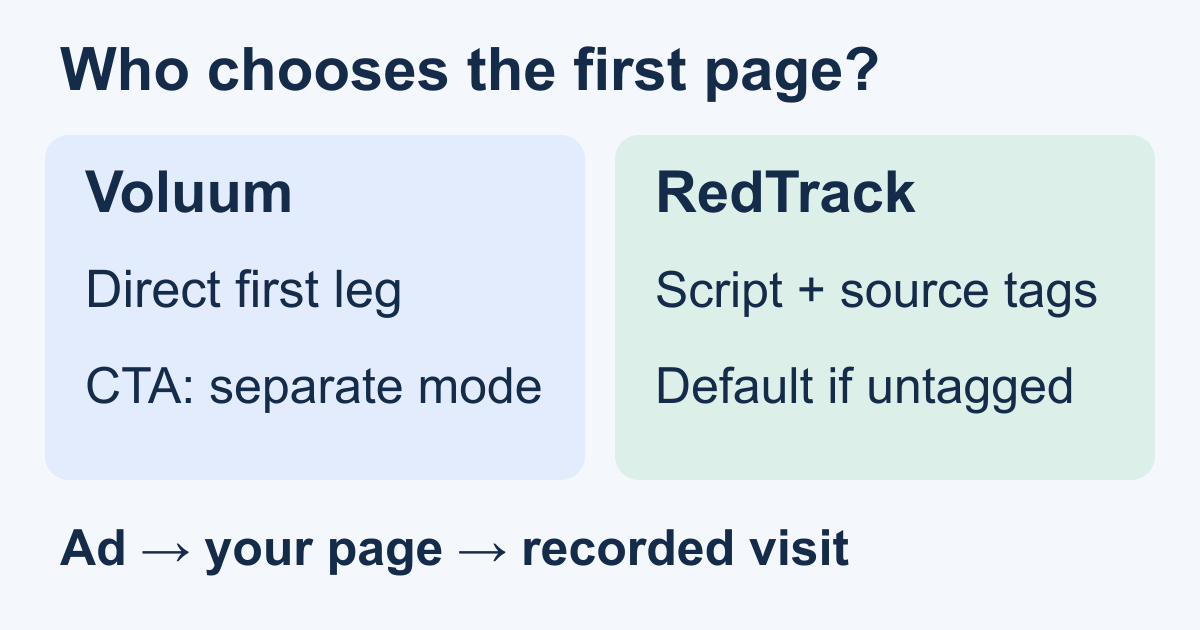
In both examples, the ad destination has already chosen which introduction page opens. An arrival script reports that visit. It cannot go back in time and select a different first page for the same arrival.
RedTrack's testing FAQ makes the distinction explicit: its landing-page A/B testing uses redirect tracking, while offer split testing can use either redirect or no-redirect tracking. Likewise, keep Voluum's first-transition restriction separate from the later CTA. “No entry redirect” is not shorthand for “no offer testing.”
If the real requirement is to randomly distribute arrivals between two introductions, evaluate the applicable entry-routing setup separately. Two ads that happen to use different pages are not automatically a randomized landing-page A/B test. Neither a mode label nor a click count proves a fair assignment.
Read one buyer's test before changing budget
Consider three hypothetical QA visits, not customer performance: one correctly tagged visit from paid channel A, one from paid channel B, and one untagged control. Open each published link and check the intended page, recorded campaign and onward destination.
Suppose the RedTrack B test appears in the default campaign. The buyer knows that visit came from a paid test link, so the fallback does not establish an organic acquisition. Compare the generated parameters with the link actually used by the channel, inspect the selected script and retest the mapping. In Voluum, independently verify that the copied direct URL records the visit in its intended campaign and that the separately configured CTA reaches enrolment.
Completed enrolments need another connection. Voluum documents postback or pixel conversion tracking; RedTrack documents conversion integrations, postbacks and scripts. A postback is a message reporting a completed outcome from another system. Confirm a permitted test enrolment in the destination and its intended tracker report, using consistent click identity and source labels.
Only after this path is understood should the buyer compare mature channel outcomes and test a page promise or destination change. A missing tracker visit does not prove the person never loaded the page; script execution and browser conditions need checking. Missing enrolment reporting is unavailable evidence, not a measured zero or a reason to reduce that channel's budget.
Verify the journey, then choose the workflow
- Record who maintains the introduction, destination and embedded script.
- Copy the generated URL or parameters for the selected method. Test each paid channel and an untagged control.
- Confirm the first page and every onward button on desktop and phone.
- Verify the recorded campaign, then a completed test enrolment. Treat these as different observations.
- After changing a URL, script setting or destination, retest before comparing results.
Voluum's per-transition setup is useful to trial when the buyer wants to make each stage explicit. RedTrack's Universal workflow is useful to trial when the existing page receives several paid channels and untagged traffic. Both require a maintained page and verified outcome reporting; these examples do not establish exclusive capabilities, tracking-accuracy rankings or guaranteed ad approval.
If the missing requirement is instead a supplied, hosted campaign page, MeetROAS offers that page-oriented workflow, including PWA campaign pages. A PWA is a website that can be installed and opened like an app. An arrival or CTA click does not prove installation or first open; verify those stages separately. That page-creation need differs from adding direct tracking to the custom page in this example.
Sources
- Voluum: Track with a Direct Method — Checked: 2026-11-16
- RedTrack: No redirect / redirectless tracking — Checked: 2026-11-16
- RedTrack: Universal tracking script — Checked: 2026-11-16
- RedTrack: FAQ, split-testing scope — Checked: 2026-11-16
- Voluum: Track Conversions — Checked: 2026-11-16
- RedTrack: Conversion tracking: S2S, script, API — Checked: 2026-11-16
- MeetROAS: Campaign pages — Checked: 2026-11-16