What changes between a landing page and a direct link?
Go directly to the product page when it already delivers the ad's promise. Test an extra explanatory page when visitors need to understand eligibility, use or terms before taking the next step. Judge that extra step by completed business outcomes and cost across the same assigned audience, not just clicks on its button.
Here, “landing page” means an additional introductory page before the product page, often called a pre-lander. A direct link takes people straight to that same product page, such as a course platform's registration page. The offer is the promoted proposition or destination, rather than the extra introduction.
Google Ads uses a broader definition: the page someone reaches after clicking an ad is a landing page. A direct product destination therefore still has one. This comparison asks whether to add a page, not whether to have a website or use a tracking URL.
When does the extra page have a useful job?
Suppose an online course platform advertises a chance to try a lesson before deciding. New visitors may need to see eligibility, a lesson sample and subsequent fees. Someone searching for a specific course may simply want to register. Start with that visitor's task, rather than putting every audience through the same introduction.
| Visitor's problem | What a pre-lander can do | When direct access makes sense |
|---|---|---|
| Unsure whether the service fits | Explain use and eligibility | The product page already answers it |
| Ad mentions only one benefit | Add essential terms, fees and next step | Product page matches the ad's promise |
| Already selected a product or plan | May repeat information | Let the visitor start the intended action |
| Slow mobile loading and multiple hops | Adds another wait | Remove an unnecessary intermediate step |
Give the page a specific job, such as answering whether the trial automatically becomes paid access. Repeating the ad at greater length is not a reason by itself. First run the message-match audit: the ad, introduction and registration page should not contradict one another. An extra click cannot fix conflicting promises.
A hypothetical example: fewer arrivals, more registrations
These are invented teaching numbers, not customer results or benchmark conversion rates. Both arms use the same ad and source, run concurrently with random assignment, and end on the same product page. Each eligible person enters once at their first paid click and stays in that arm on return. Observe everyone for seven full days and count one successful registration per person. Assume assignment records and outcome linkage are complete. Each arm spends US$200.
| Measure | Direct to product | Through pre-lander |
|---|---|---|
| People assigned | 1,000 | 1,000 |
| Reach product page | 800 | 600 |
| Complete registration | 40 | 48 |
| Registrations per assigned person | 4.0% | 4.8% |
| Registration rate after product arrival | 5.0% | 8.0% |
| Ad spend | US$200 | US$200 |
| CPA per completed registration | US$5.00 | About US$4.17 |
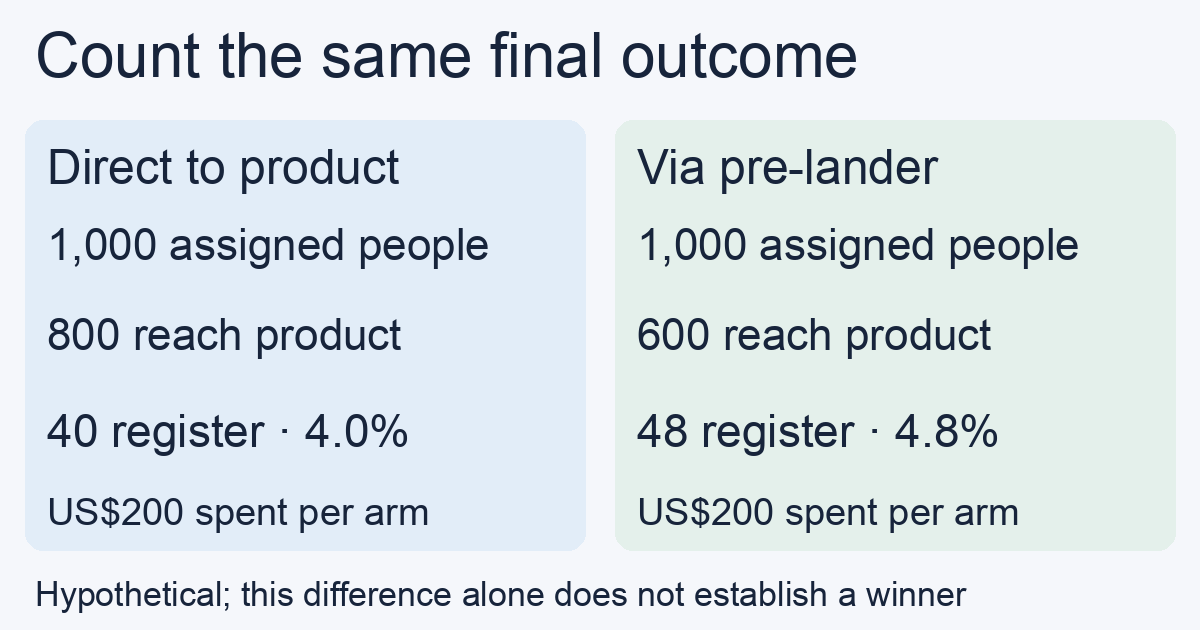
The main registration rate = people completing registration / people assigned × 100%. For the pre-lander arm, 48 / 1,000 = 4.8%. Registration CPA = that arm's ad spend / completed registrations, so 200 / 48 is approximately US$4.17.
The 8% rate describes only the 600 people who reached the product page. An extra step may filter people before that point, so those 600 and the direct arm's 800 are different downstream groups. Comparing 8% with 5% alone cannot show that the product page itself improved. Keeping all assigned people in the main denominator includes the loss before arrival.
The outcome can reverse. If the pre-lander still sends 600 people to the product but only 6% register, it produces 36 registrations and a CPA of about US$5.56. With those 600 arrivals held constant, its downstream rate must exceed 40 / 600, about 6.67%, to beat 40 registrations. That is conditional arithmetic. The original 48-versus-40 difference does not by itself establish a reliable test winner.
Set up a test with one question and a common denominator
Google Ads' experiment guidance recommends a clear hypothesis, one changed variable and success measures selected before the test. Apply those principles to route selection:
- Name the pre-lander's job. For example, “Explaining trial terms first increases valid registrations per assigned person,” rather than “It increases engagement.”
- Hold the other conditions steady. Keep the ad, source, audience, product, promotion and period comparable. Use an applicable platform experiment or a verified random-assignment mechanism. Two arbitrary independently delivered campaigns do not automatically constitute a fair experiment.
- Preserve assignment. Define the first assignment, return visits and limits of cross-device linkage. A person whose assigned page fails to load must not quietly disappear from the main denominator.
- Complete both real paths. On the target phone, check the page, button, destination parameters and returned registration success. Clicking “continue” is not a completed registration. Investigate an absent outcome feed before interpreting it as zero.
- Allow equal maturity. Seven days is an illustrative agreement, not a universal window. Follow the conversion-delay checks, give each entrant equal follow-up, and predefine the budget, stopping rules and treatment of uncertainty.
Changing the audience, discount and registration form during the test makes it difficult to attribute a difference to the extra page. Keep the conclusion open when coverage or sample size is insufficient; do not switch to a prettier intermediate metric just to select a winner.
What should determine the decision?
Report assignment volume, the common business outcome, actual spend and observation window for each arm first. Then use the campaign funnel to locate where their paths diverge. The pre-lander's button click rate can explain progression; it cannot replace the final completion rate per assigned person. If spend differs, use each arm's actual cost: equal traffic allocation does not guarantee equal expense.
If the business goal is paying customers, continue to comparable paid or qualified outcomes over the same period. A lower registration CPA does not guarantee a lower paying-customer acquisition cost. Different prices, refunds or customer values require a separate comparison on consistent value and cost definitions. Restore reliable outcome coverage before judging performance, and preserve uncertainty when the sample is too small.
Installing a PWA adds a website entry that can be opened again; it is a different action from registration. If one arm includes installation and the other goes straight to the site, compare their common registration or business outcome. Use installation and first open as additional diagnostic steps. One arm's installs cannot substitute for the other's registrations.
For the same comparison with a PWA install step, see MeetROAS vs Binom and how both setups connect to the same signup outcome.
Four questions before launch
- What question does this extra page answer that the product page does not?
- Does the same ad still lead to the same offer, fees and next action?
- Can you reconcile assignment, arrival and genuine successful outcomes?
- Which final outcome, cost and uncertainty conditions would make you keep or remove the page?
Check that the ad platform, affiliate arrangement and destination permit the chosen links and redirects. Route testing does not remove destination-policy requirements. Preserve the actual displayed page and final URL in the test record.
MeetROAS provides hosted campaign pages and direct website campaigns, helping observe page/PWA stages alongside connected outcomes such as registrations. Its event reference identifies the business events the destination needs to supply. Confirm that actual allocation, cost and outcome coverage satisfy the test rules above, then decide whether the extra page earned its place.
Sources
- Google Ads: Landing page — Checked: 2026-11-07
- Google Ads: Test with confidence with the Experiments page — Checked: 2026-11-07
- MeetROAS: Current campaign pages and direct website workflow — Checked: 2026-11-07
- MeetROAS: Destination business events — Checked: 2026-11-07